Specification and Compatibility Table
| Product | Type | Stages / Capacity | Ports | Notable claims | Price |
|---|---|---|---|---|---|
| PRO+AQUA PRO-E-S80E Elite Combo | Combo (softener + filter) | 80,000 grain softener + filtration | Not stated | Large homes and well water use | $1445.56 |
| Kenmore Elite 520 Hybrid | Combo (softener + filter) | 2-in-1, NSF-certified | Not stated | Softener plus filter for drinking water | $978.34 |
| iSpring WGB32B-KS | Whole house filter | 3-stage | Not stated | Reduces heavy metals, hydrogen sulfide, chlorine, chloramine, sediment; 4.7 stars across 166 ratings | $407.09 |
| PRO+AQUA PRO-100-E GEN2 | Whole house filter | 3-stage | 1" | City and well; pressure gauges; reduces sediment, chemicals, heavy metals | $371.67 |
| 3-Stage Home Filtration (with extra filters) | Whole house filter | 3-stage, 1.5-2 year filter life | 3/4" with 2 valves | Reduces chlorine, sediment, taste; well and city | $185.99 |
| iSpring WGB21B | Whole house filter | 2-stage, 10" x 4.5" sediment + CTO | 1" | Reduces chlorine, taste, odor | $155.99 |
Last Updated: July 28, 2026
The products referenced on this page carry a combined 166+ verified Amazon customer ratings.

- Perfect for Families: Designed for households of any size dealing with hard water and chlorine taste or odor. The Kenmore Elite 520 softens and reduces clear water iron, while
- Drinking Water Filtration: Combines a water softener with a built-in carbon media filter to reduce chlorine taste and odor—no need for a separate pre filter. Enjoy better-tasting
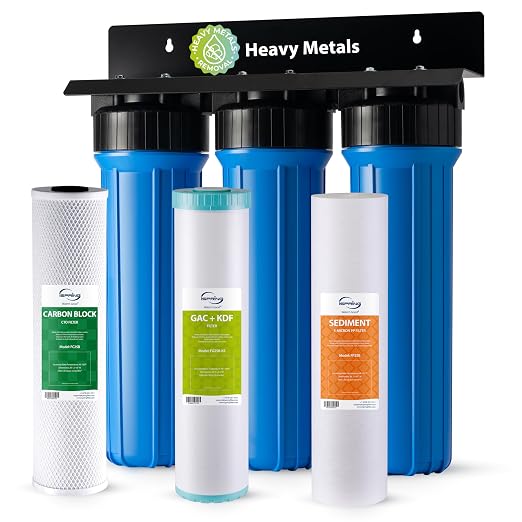
- PROTECT YOUR FAMILY AND APPLIANCES - The 2nd-stage FG25B-KS 20” x 4.5” compound filter removes chlorine, lead, mercury, hydrogen sulfide, heavy metals, pesticides, herbicides
- DIY INSTALLATION AND MAINTENANCE - This whole house water filtration system comes with easy-to-follow manual and YouTube videos for hassle-free DIY installation. 1” NPT
The Short Answer
A water softener removes hardness minerals (calcium and magnesium) so you stop getting scale and dry skin, but it does not remove chlorine, sediment, or taste problems. A whole house filter removes sediment, chlorine, and chemical contaminants but does nothing about hardness. If your water is both hard and dirty-tasting, a combo system does both jobs in one footprint, which is why combos exist for exactly this overlap.
Choose by testing your water first: hardness above about 7 grains per gallon points to a softener, a chlorine or rotten-egg smell points to a filter, and both problems together point to a combo.
What Each System Actually Does
Water softener
A softener runs your water through resin beads that swap calcium and magnesium for sodium, then periodically regenerates using brine from a salt tank. That ion exchange is the only thing it does. It will not improve taste, remove chlorine, or catch sediment.
You want one when you see white scale on faucets, spots on glassware, soap that will not lather, and stiff laundry. Softener capacity is rated in grains, such as the 80,000-grain rating on the PRO+AQUA combo below, which describes how much hardness it can remove between regenerations.
Whole house filter
A whole house filter sits at your main line and treats every tap. Multi-stage units use a sediment stage plus carbon stages to cut chlorine, chloramine, taste, odor, and in some designs heavy metals and hydrogen sulfide. The iSpring WGB32B-KS, for example, is described as reducing heavy metals, hydrogen sulfide, chlorine, chloramine, and sediment across three stages.
A filter does not soften. If your water is hard, a filter alone will leave the scale problem untouched.
Combo system
A combo pairs softening resin with filtration media so one install handles hardness and contaminants. The Kenmore Elite 520 is described as an NSF-certified 2-in-1 softener plus filter, and the PRO+AQUA PRO-E-S80E pairs an 80,000-grain softener with a whole house filtration stage for large homes and well water. Combos cost more up front and take more space, but they solve the both-problems case in a single unit.
How to Choose: A Step-by-Step Checklist
- Test your water before buying anything. Use a hardness test strip and, on a private well, a broader contaminant test. Gotcha: buying a softener when your real complaint is chlorine taste means you will spend money and still hate your water.
- Identify city vs well. City water usually means chlorine or chloramine to remove; well water can add sediment, iron, and hydrogen sulfide. Gotcha: chloramine is harder to remove than chlorine, so confirm your filter names chloramine, as the iSpring WGB32B-KS and the 3-stage well-and-city unit do.
- Match hardness to grain capacity. Higher hardness and more people means you want more grains so the unit regenerates less often. Gotcha: an undersized softener regenerates constantly, wastes salt, and wears out faster.
- Measure your space and ports. Check the pipe size you are tying into. Port sizes in the data range from 3/4-inch on the budget 3-stage unit to 1-inch on the iSpring WGB21B and PRO+AQUA PRO-100-E. Gotcha: a port mismatch means adapters, and adapters can throttle flow.
- Decide filter-only, softener-only, or combo. One problem points to a single-purpose unit; both problems point to a combo like the Kenmore Elite 520 or PRO+AQUA PRO-E-S80E. Gotcha: two separate units cost less individually but need two installs and two footprints.
- Plan a drain and, for softeners, a salt tank location. Softeners and any regenerating unit need a drain line for backwash. Gotcha: no nearby drain is the most common reason a planned install stalls halfway.
- Install with a bypass and shutoffs. Fit isolation valves so you can service the unit without killing water to the house. The budget 3-stage system ships with 2 valves for this reason. Gotcha: skip the bypass and every filter change becomes a whole-house shutoff.
- Flush and pressure-check before you trust it. Run water through a new filter to clear carbon fines, then watch a pressure gauge. The PRO+AQUA PRO-100-E includes pressure gauges specifically so you can see restriction. Gotcha: a big early pressure drop usually means air or a clogged sediment stage, not a bad unit.
What Goes Wrong
Pressure drops across the house
Symptom: weak flow at every tap after install or after months of use. On filters this almost always means a loaded sediment stage; on softeners it can mean a fouled resin bed. Fit or read a pressure gauge, and change the sediment cartridge first before assuming the unit failed.
Water still feels hard
Symptom: scale and no slippery feel after installing a softener. Usual causes are an empty salt tank, a salt bridge (a hard crust holding salt up off the water), or a softener sized too small for your hardness. Break the bridge, keep the tank filled, and confirm your grain capacity matches your grains-per-gallon.
Taste or smell did not improve
Symptom: chlorine or rotten-egg smell remains. If you installed a softener expecting this, that is the wrong tool, since softeners do not touch taste. If you have a filter, confirm it names your specific problem; hydrogen sulfide and chloramine need media rated for them, such as the iSpring WGB32B-KS.
Salty-tasting water
Symptom: a faint salty taste after a softener install. This can be a regeneration cycle set too rich or a valve stuck mid-cycle. Manually regenerate once, then verify the cycle completes and the drain runs freely.
Leaks at the fittings
Symptom: drips at the inlet or outlet threads. New systems commonly weep at the first connections. Re-tape the threads, hand-tighten plus a controlled turn, and never over-torque plastic housings, which crack.
When the Fix Is a New One
Keep working on your existing setup when the problem is a cartridge, salt level, or fitting. Replace the system when the housing is cracked, the resin no longer softens after a proper regeneration, or your water problem changed and the unit was never built for it. Check current reviews on any product page yourself before buying to see how other owners describe long-term reliability.
You have both hardness and contaminants
If a filter-only setup left you with scale, or a softener left you with bad taste, a combo replaces both jobs in one install. The PRO+AQUA PRO-E-S80E pairs an 80,000-grain softener with filtration and is aimed at large homes and well water, which changes the calculation when you are tired of running two systems. Check Price on Amazon
You want softening and filtering in a smaller, certified package
The Kenmore Elite 520 is described as an NSF-certified 2-in-1 softener plus filter, which matters if third-party certification is what would let you stop second-guessing the water. It changes the task from managing two units to managing one. Check Price on Amazon
Your problem is contaminants, not hardness
If testing shows chlorine, chloramine, hydrogen sulfide, or heavy metals but hardness is fine, a filter-only unit is the honest replacement. The iSpring WGB32B-KS names all four of those in a 3-stage design, so it changes a taste-and-contaminant problem without adding softening you do not need. Check Price on Amazon
FAQ
Do I need a softener or a filter?
Test first. Scale, spotting, and poor lather point to a softener; chlorine taste, odor, or sediment point to a filter. Both symptoms together point to a combo.
Will a whole house filter soften my water?
No. Standard carbon and sediment filters do not remove hardness minerals. If you have scale, you need a softener or a combo that includes softening resin.
Is a combo system worth it over two separate units?
A combo like the Kenmore Elite 520 or PRO+AQUA PRO-E-S80E saves space and gives you one install for both problems. Two separate units can cost less individually but need two footprints, two sets of plumbing, and two service routines.
What size softener do I need?
Match grain capacity to your hardness and household size so the unit does not regenerate constantly. Higher hardness and more people call for more grains, such as the 80,000-grain rating on the PRO+AQUA combo. Confirm your grains per gallon with a test before buying.
Can these systems handle well water?
Several are described for well use, including the PRO+AQUA PRO-E-S80E, the PRO+AQUA PRO-100-E, and the budget 3-stage unit. Well water often adds sediment and hydrogen sulfide, so pick a unit that names those, and expect to change sediment cartridges more often.
Where can I check for recalls or safety notices?
For any water treatment product, verify current safety information at the U.S. Consumer Product Safety Commission recalls page before you buy or install.
How often do I change filters or add salt?
Filter life varies by design; the 3-stage unit above lists a 1.5 to 2 year filter life for its cartridges, while sediment-heavy water shortens that. Softeners need salt whenever the tank runs low, and you should break up any salt bridge that forms so regeneration actually works.