Specification and Compatibility Table
Built only from the manufacturer data for each system. Where a value was not published in that data, it reads "Not stated" rather than a guess.
| System | Type / Stages | Ports | Softener Capacity | Water Source | Price |
|---|---|---|---|---|---|
| PRO+AQUA PRO-E-S80E Elite Combo | Filtration + softener combo | Not stated | 80,000 grain | City & well (large homes) | $1445.56 |
| Kenmore Elite 520 Hybrid | 2-in-1 softener + filter, NSF-certified | Not stated | Not stated | Not stated | $978.34 |
| iSpring WGB32B-KS | 3-stage filtration | Not stated | Not applicable | City & well | $407.09 |
| PRO+AQUA GEN2 PRO-100-E | 3-stage filtration, pressure gauges | 1" | Not applicable | City & well | $371.67 |
| 3-Stage Home System (with 2 extra filter sets) | 3-stage filtration | 3/4" | Not applicable | City & well | $185.99 |
| iSpring WGB21B | 2-stage filtration (10" x 4.5" sediment + CTO) | 1" | Not applicable | Not stated | $155.99 |
Last Updated: July 28, 2026
The products referenced on this page carry a combined 166+ verified Amazon customer ratings.
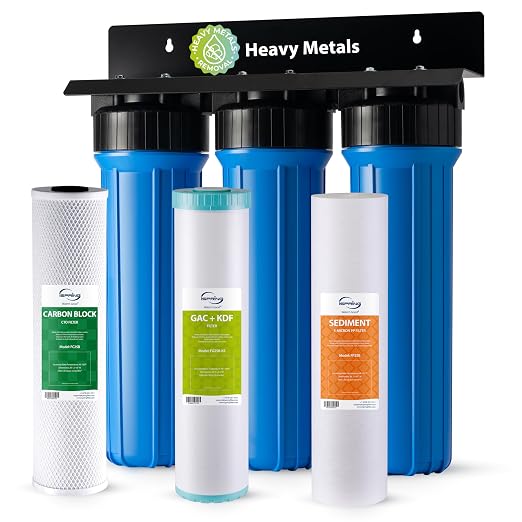
- PROTECT YOUR FAMILY AND APPLIANCES - The 2nd-stage FG25B-KS 20” x 4.5” compound filter removes chlorine, lead, mercury, hydrogen sulfide, heavy metals, pesticides, herbicides
- DIY INSTALLATION AND MAINTENANCE - This whole house water filtration system comes with easy-to-follow manual and YouTube videos for hassle-free DIY installation. 1” NPT
The Short Answer
Size a whole house filter to your home's peak flow rate in gallons per minute (GPM), not to your household size or square footage. Add up the fixtures that can run at once, match a filter rated at or above that GPM, and make sure its port size (typically 3/4" or 1") matches your main line so you don't choke pressure. If you also have hard water, size the softener separately by grain capacity, which is your grains-per-gallon hardness multiplied by daily gallons used.
Why Flow Rate Is the Number That Matters
Almost every undersized filter fails for the same reason: the buyer picked it by price or by "3-stage vs 2-stage" and never checked GPM. A filter that can't pass enough water becomes a restriction in your main line, and every shower, tap and appliance downstream feels it.
Estimate your peak demand first
Peak demand is the most water your home will ever pull at one instant, not your daily average. A rough fixture-count method works well for sizing:
- Shower: 1.5-2.5 GPM
- Bathroom sink: 1-1.5 GPM
- Kitchen sink: 1.5-2.2 GPM
- Toilet refill: 2-3 GPM
- Washing machine: 3-5 GPM
- Dishwasher: 1-2 GPM
Assume two or three of these run simultaneously during a busy morning. A single-bathroom home often peaks around 6-8 GPM; a two-to-three-bathroom home commonly peaks 8-12 GPM. Size the filter at or above that number with headroom, because filters lose flow as the media loads up.
Match the port size to your main line
A high-GPM housing on 3/4" ports still bottlenecks at the ports. If your main line is 1", buy 1" ports. Larger "10 x 4.5" (big blue) housings pass more water at lower pressure loss than the slim 10 x 2.5 cartridges, which is why they dominate whole-house use.
Step-by-Step: Size Your System in Order
- Test your water first. Get a report for hardness (grains per gallon), chlorine or chloramine, sediment, iron and hydrogen sulfide. Gotcha: chloramine needs catalytic carbon, not standard carbon, so this decision changes which unit you buy.
- Measure your main line diameter. Look at the pipe right after your meter or pressure tank. Gotcha: don't guess from the fixture supply lines, which are narrower than the main.
- Calculate peak GPM. Add the fixtures likely to run together. Gotcha: include the washing machine and any irrigation, which are silent flow hogs.
- Check your static and dynamic pressure. A cheap hose-bib gauge reads static pressure; watch it drop when you open taps. Gotcha: if you already sit near 40 psi, you have almost no room for filter pressure loss and must oversize.
- Pick the filter rated at or above your peak GPM. Gotcha: manufacturer GPM ratings are for clean cartridges; real flow falls as they load, so leave 20-30% headroom.
- Size the softener separately if water is hard. Multiply hardness (gpg) by daily gallons (about 75 gallons per person) to get grains removed per day. Gotcha: don't buy a softener that regenerates daily; size for roughly weekly regeneration to protect the resin and save salt.
- Confirm port and fitting compatibility. Gotcha: reducing 1" ports down to 3/4" fittings throws away the capacity you paid for.
- Plan the bypass and service clearance. Gotcha: leave room above the housings to drop cartridges out; measure before you plumb, not after.
What Goes Wrong When You Size It
Pressure drops across the whole house
Symptom: weak showers, slow-filling toilets, appliances that complain. Cause: the filter's GPM rating is below your peak demand, or a loaded sediment cartridge is strangling flow. Fix: move to a larger 4.5" housing, upsize ports, or change the first-stage sediment filter more often.
Filters clog far too fast
Symptom: cartridge life measured in weeks, not months. Cause: heavy sediment or iron hitting a fine filter with no coarse pre-stage. Fix: add a coarser sediment stage ahead of the fine one, or a spin-down pre-filter on well water.
Chlorine taste survives the filter
Symptom: water still smells of pool. Cause: flow rate is above what the carbon can treat, so contact time is too short, or the source uses chloramine. Fix: slow the flow with a larger unit, or switch to a system with catalytic carbon rated for chloramine.
Softener does nothing for scale
Symptom: spotting and scale return within days. Cause: grain capacity undersized for your hardness, so the resin exhausts between regenerations. Fix: recalculate grains-per-day and step up to a higher-grain unit, or set more frequent regeneration.
Leaks at the housing after install
Symptom: weeping at the sump threads. Cause: dry or pinched O-ring, or over-tightening. Fix: lubricate the O-ring with silicone grease, seat it flat, and hand-tighten plus a quarter turn only.
When the Fix Is a New One
Some sizing problems can't be tuned away. If your housing is simply too small for your peak GPM, or you're stacking pre-filters to compensate for a unit that never had the capacity, replacing it is cheaper than fighting it. These are honest signals to move on, and the three below change different things about the sizing job. Check current pricing and the published specs before you commit.
You need real flow and 1" ports
If small ports are your bottleneck, a unit that ships with 1" ports and built-in pressure gauges lets you actually watch the pressure loss instead of guessing. The PRO+AQUA Elite Series GEN2 PRO-100-E is a 3-stage system for city and well water with 1" ports and gauges on the housings. Check Price on Amazon
Your water has heavy metals or chloramine
If a basic carbon filter is losing to chloramine or dissolved metals, you need media rated for it rather than more cartridges. The iSpring WGB32B-KS is a 3-stage system that targets heavy metals, hydrogen sulfide, chlorine, chloramine and sediment, and it carries a 4.7-star rating across 166 ratings you can read for yourself. Check Price on Amazon
You have hard water and a large home
If you're sizing filtration and softening together for a big household or a well, a combined unit removes the mismatch between two separate systems. The PRO+AQUA PRO-E-S80E Elite pairs whole-house filtration with an 80,000-grain softener, aimed at large homes and well water. Check Price on Amazon
Frequently Asked Questions
What GPM do I need for a whole house filter?
Match the filter to your peak simultaneous demand, not your average use. One-bathroom homes often peak near 6-8 GPM and two-to-three-bathroom homes near 8-12 GPM, so pick a rating at or above that with headroom for cartridge loading.
Does a bigger filter housing reduce water pressure?
A correctly sized 4.5" housing loses less pressure than a slim cartridge because water passes through more media area at lower velocity. Pressure problems come from undersizing or a clogged first stage, not from the housing being large.
How do I calculate water softener grain capacity?
Multiply your hardness in grains per gallon by your daily water use (about 75 gallons per person). That is grains removed per day; pick a softener sized to regenerate roughly weekly, not daily, so the resin lasts and salt use stays reasonable.
Do I need 3/4" or 1" ports?
Buy ports that match your main line diameter measured right after the meter or pressure tank. Putting 3/4" fittings on a 1" line throws away flow capacity, and reducing at the ports recreates the bottleneck you were trying to avoid.
How often should whole house filters be changed?
It depends on sediment load and flow, not a fixed calendar. Watch the pressure drop across the system; when it climbs or your flow noticeably weakens, change the sediment stage first. Some systems publish long filter lives, but your water quality is the real clock.
City water or well water: does sizing change?
Well water usually carries more sediment, iron and hydrogen sulfide, so it needs a coarse pre-stage and often more capacity than city water at the same GPM. Test both, but expect a well to load filters faster and demand catalytic or specialized media more often.