Iron fouling is the silent killer of softener performance, and it's the leading cause of channeling inside a Fleck 5600SXT control valve. To prevent Fleck 5600SXT resin channeling from iron fouling, you need three layers working together: aggressive pretreatment that keeps ferrous and ferric iron out of the resin tank, a programmed backwash that fully lifts the bed at 5–7 GPM, and routine regeneration with a resin cleaner like Iron Out or Pro Rust Out. Skip any of those and the bed forms preferential flow paths, hardness slips through to your fixtures, and the softener becomes an expensive paperweight within 12–18 months.
Why iron fouls the resin and creates channels
Standard 8% crosslink cation resin loves iron almost as much as it loves calcium and magnesium. The catch is that iron doesn't release during a normal brine regeneration. Ferrous iron (Fe²⁺) enters the tank dissolved and invisible, but once it contacts air pockets or chlorinated water it oxidizes to ferric iron (Fe³⁺) and precipitates as a sticky orange sludge that coats individual resin beads.
Over weeks and months that sludge cements clusters of beads together. Backwash water then takes the path of least resistance — around those clumps instead of through them — and your bed develops vertical channels. Hard, untreated water rockets straight through, the resin under the channel gets exhausted, and the resin around the channel sits unused. You'll notice it as sudden hardness breakthrough between regenerations, slick-feeling water that turns gritty by Thursday, or orange staining returning to toilets and laundry even though the brine tank is full.
The Fleck 5600SXT is mechanically excellent, but it cannot regenerate iron-fouled resin on its own. Prevention is the only economical strategy in 2026, especially with replacement resin running $80–$120 per cubic foot.
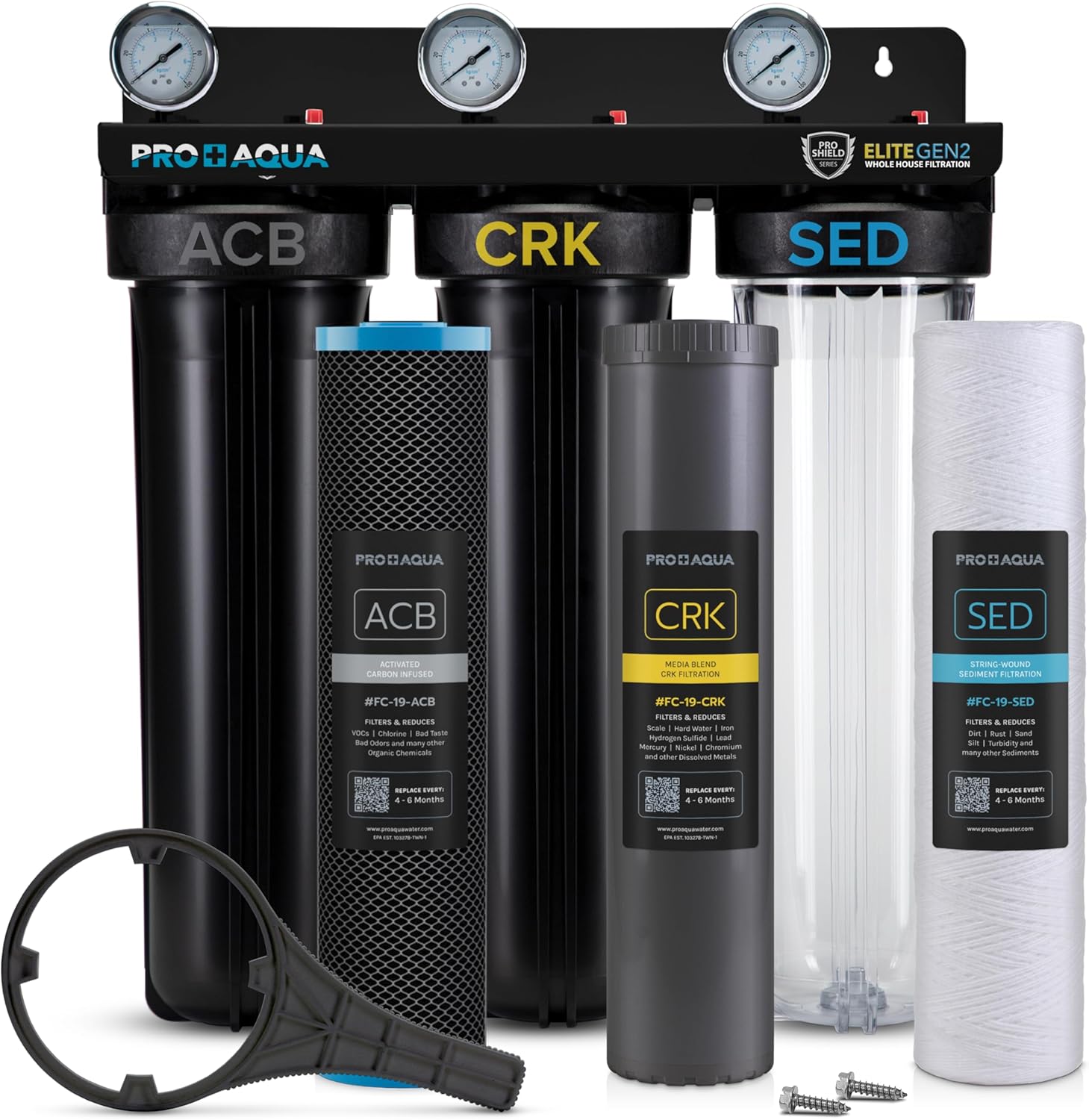
The four-layer prevention protocol
To prevent Fleck 5600SXT resin channeling from iron fouling, build pretreatment in this order, from the well or service line inward:
- Sediment prefilter (5 micron): Catches ferric iron flocs, sand, and silt before they hit the softener inlet.
- Dedicated iron filter: Air-injection, KDF-85, or manganese greensand — sized for your iron level (anything above 0.3 ppm needs one).
- Carbon block (optional but recommended): Removes chlorine that would otherwise oxidize residual iron inside the resin tank itself.
- Fleck 5600SXT with proper programming: Higher salt dose, shorter regen interval, and an additive resin cleaner in the brine well.
Most homeowners try to do this with just step 4 plus a rust-remover salt — that predictably fails above 0.5 ppm iron. See our guide to choosing an iron filter for well water for sizing math by iron concentration and household flow demand.

Best pretreatment products to protect your Fleck 5600SXT in 2026
The table below summarizes the five pretreatment components we recommend most often for homes running a Fleck 5600SXT on iron-loaded water. Pick one prefilter plus one iron-removal stage based on your tested iron level.
| System | Best for | Iron capacity | Stages | Service life |
|---|---|---|---|---|
| iSpring Iron & Manganese | Wells >1 ppm iron | Up to 3 ppm Fe / 1 ppm Mn | Tank-based backwash | 5+ years media |
| Aquasana 500K Whole House Well | Wells with iron + bacteria | Up to ~0.3 ppm | UV + KDF + carbon | 500,000 gal |
| Express Water 3-Stage | City or low-iron well | Up to ~0.5 ppm sediment iron | Sediment + KDF + carbon | ~100,000 gal |
| HQUA WF3-01 3-Stage | Budget low-iron setups | Sediment iron only | Sediment + carbon + GAC | ~80,000 gal |
| Aquaboon 5 Micron Sediment | Drop-in prefilter housing | Catches ferric floc only | 1 | 3–6 months |
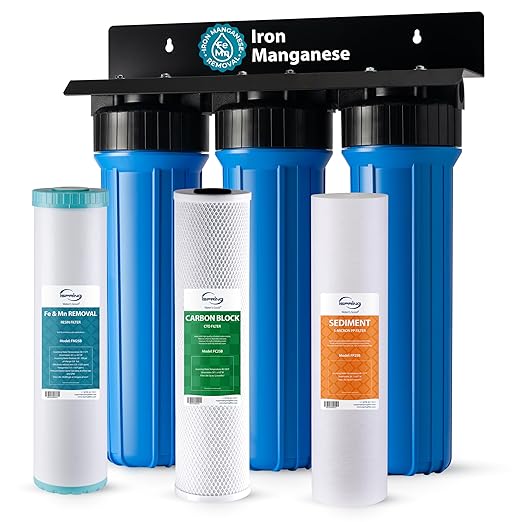
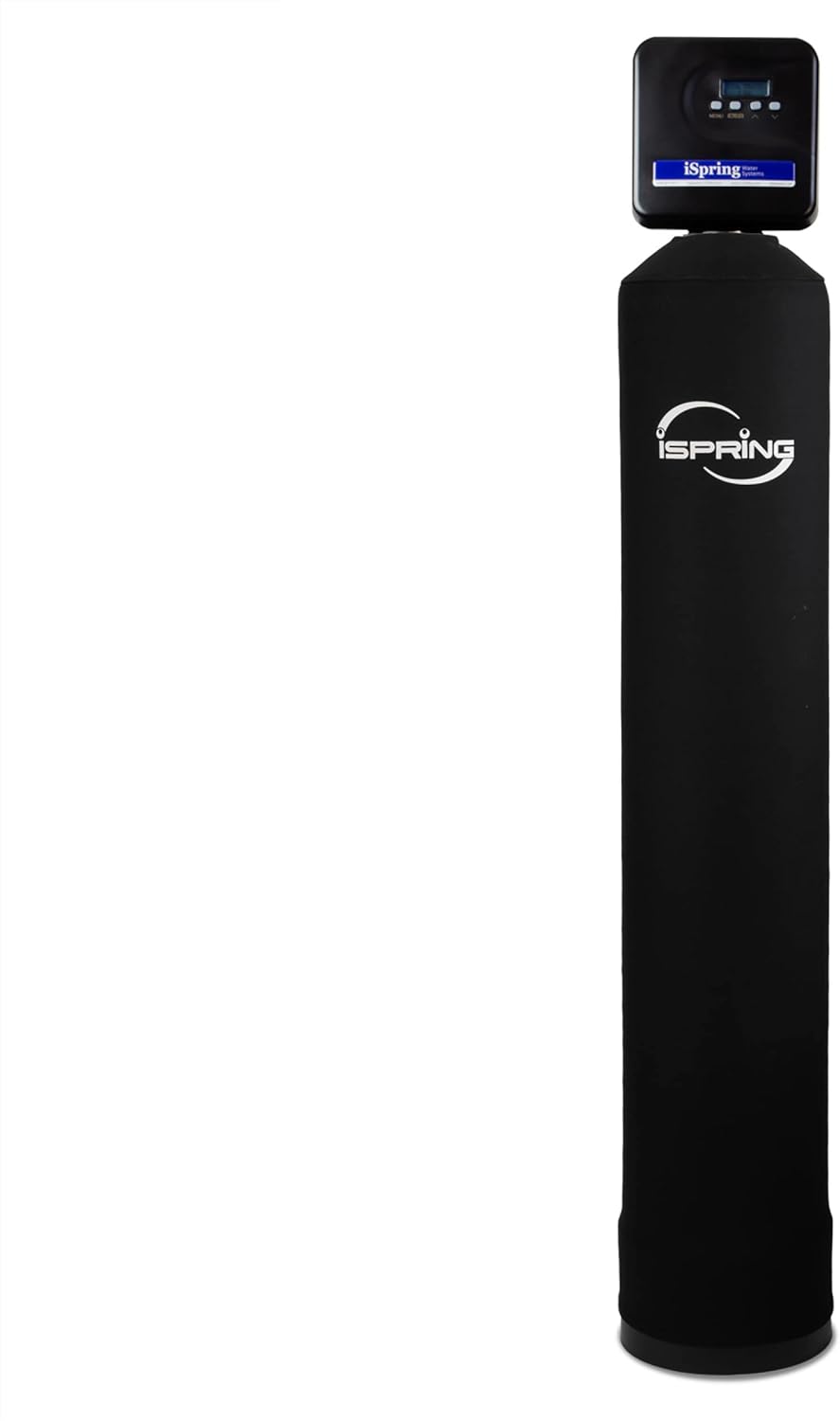
iSpring Iron & Manganese Whole House Filtration — best dedicated iron removal
If your water test shows more than 1 ppm total iron, this is the upstream system you want. It uses a manganese-dioxide-style media in a backwashing tank to oxidize and trap both ferrous and ferric iron before they ever touch your Fleck 5600SXT resin. We've seen this combo run for years on rural wells in the 2–3 ppm range without any channeling at all. Check current pricing on Amazon.
Aquasana Whole House Well Water Filter (500K gal) — for wells with iron plus bacteria
This 500,000-gallon UV + KDF + carbon system is the right choice if your well also has bacterial contamination or any chlorine being injected upstream. The KDF stage knocks down low-level iron (under ~0.3 ppm), the UV handles microbes, and the carbon protects resin from chlorine oxidation. It's overkill if iron is your only problem, but a great whole-system buy for problem wells. See it on Amazon.
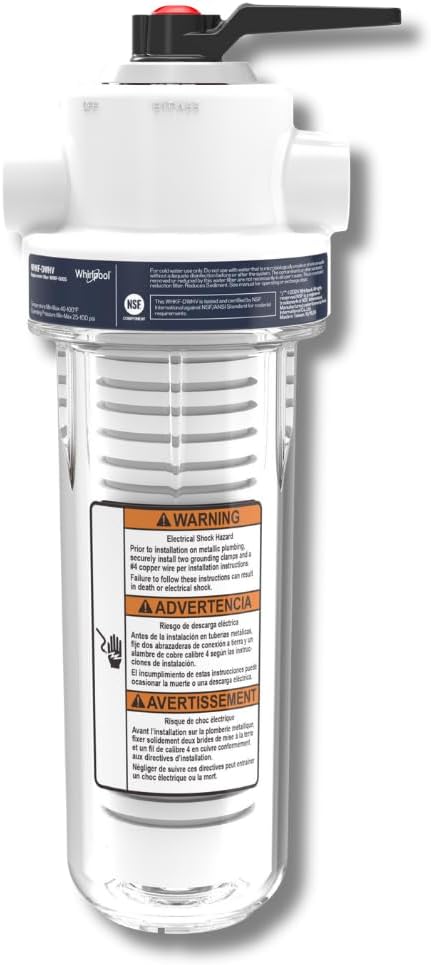
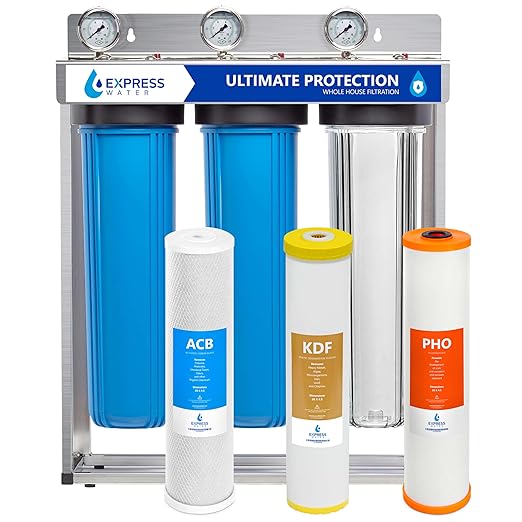
Express Water 3-Stage Whole House Water Filter — balanced city/well pretreatment
For low-iron city water or wells under 0.5 ppm, this 3-stage cartridge system gives you sediment, KDF/carbon, and a polishing carbon stage in one cabinet. Cartridges are inexpensive and easy to swap, which matters when iron floc shortens prefilter life. Pair it directly with your Fleck 5600SXT for the cleanest possible feed water. View on Amazon.
HQUA WF3-01 3-Stage Whole House — budget pretreatment for soft well water
If your water test reads under 0.3 ppm iron and you just want insurance against the occasional sediment slug, the HQUA WF3-01 is the lowest-cost serious option. Don't expect it to remove dissolved iron — it won't — but it will keep particulates from packing into the top of the softener bed and forming a crust. Check on Amazon.
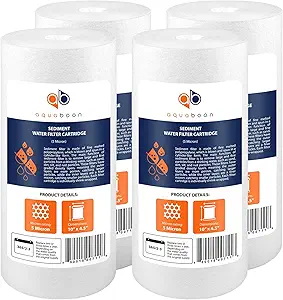
Aquaboon 5 Micron 10x4.5 Sediment Filter (4-Pack) — the prefilter you must always have
Whatever larger pretreatment system you pick, a 5-micron 10x4.5 sediment cartridge in a Big Blue housing immediately ahead of the Fleck is non-negotiable. The 4-pack is the right way to buy them, since iron-laden water will collapse a cartridge in 6–10 weeks. Set a calendar reminder and just swap on schedule. Get the 4-pack on Amazon.
Programming the Fleck 5600SXT for iron-loaded water
Even with great pretreatment, you need to dial back the SXT head defaults. The factory settings assume clean municipal water. For wells with any iron exposure, change these settings:
- Regeneration frequency: Drop to every 3–4 days regardless of meter, never the 7–14 day default.
- Salt dose: Bump to 12–15 lbs per cubic foot of resin (not the default 6–9). Higher brine strength helps strip iron back off the beads.
- Backwash time: Extend to 14 minutes. The default 10 minutes does not adequately fluidize an iron-laden bed.
- Brine refill: Match to the higher salt dose — usually 6–8 minutes for a 1 cu ft tank.
- Flow rate: Confirm your inlet delivers at least 5 GPM during backwash. Anything less and the bed simply won't lift, which guarantees channeling.
For step-by-step screen walkthroughs of each SXT parameter, see our Fleck 5600SXT settings guide for iron-heavy water.
The resin cleaning schedule that actually works
Even with pretreatment and aggressive regeneration, plan to do a manual resin cleaning every 60–90 days. The protocol is straightforward:
- Pour 8 oz of citric acid or a commercial resin cleaner (Pro Rust Out, Iron Out) directly into the brine well.
- Trigger a manual regeneration from the SXT head (hold REGEN for 5 seconds until the motor engages).
- Let the cycle complete, then immediately run a second manual regen with normal salt only to rinse residue out of the bed.
You'll usually see brown or orange tinted water at the drain on the first cycle — that's the iron leaving the resin. If you don't see any color, your bed is either clean or already too far gone to rescue. Compare resin cleaners head-to-head in our resin cleaner showdown for 2026.
Signs you're already channeling and need to act today
Don't wait for a water test to confirm channeling. Watch for these tells:
- Hardness breakthrough 1–2 days after regeneration when it used to last a week.
- Orange staining returning to toilet bowls and laundry whites.
- Reduced flow at fixtures (the bed is partially packed).
- Brown tint to the first water out after regen, lasting more than a few minutes.
- Salt bridges or mushing in the brine tank from incomplete brine draw.
If you see two or more of those, do a resin cleaning today and budget for a pretreatment upgrade this month. Together, the five products above and a properly programmed valve will prevent Fleck 5600SXT resin channeling from iron fouling for the full 8–10 year service life of the resin.
Frequently Asked Questions
How much iron can a Fleck 5600SXT actually handle without pretreatment?
Manufacturer guidance is up to 0.3 ppm ferrous iron with no upstream filtration, but real-world results above 0.2 ppm show fouling within 12 months. Anything ferric (already oxidized) needs filtration regardless of concentration, because resin cannot strip particulate iron during regeneration.
Will iron-removal salt alone prevent channeling on a Fleck 5600SXT?
No. Rust-remover salts like Morton Rust Remover or Diamond Crystal Iron Fighter add a citric acid additive that helps marginally on iron under 0.5 ppm. Above that you need a dedicated iron filter ahead of the softener — salt additives cannot keep up with the iron load.
How often should I backwash a Fleck 5600SXT on well water with iron?
Set the day-override to force a regeneration every 3–4 days. Iron sludge sets up faster than calcium scale, so frequent backwashing is the cheapest way to keep the bed fluidized. Don't rely on the meter alone, which will skip regens during low-usage weeks.
Can I rescue a Fleck 5600SXT that's already channeling, or do I need new resin?
If channeling started in the last 60 days, three back-to-back resin cleanings with Pro Rust Out usually restore capacity to 80–90%. If you've been seeing breakthrough for six months or more, the resin is likely fused into clumps and replacement (about $80–$120 for 1 cu ft of 8% crosslink resin) is the practical fix.
Does a whole house sediment filter prevent iron fouling on its own?
A sediment filter only catches already-oxidized (ferric) iron particles. Dissolved ferrous iron passes right through any micron-rated cartridge. A 5-micron prefilter is necessary but not sufficient — you still need an oxidation/iron-removal stage if your water has any dissolved iron at all.
What backwash flow rate does the Fleck 5600SXT need on an iron-fouled bed?
You need a minimum of 5 GPM, ideally 7 GPM, at the drain line during backwash. Low-flow wells often can't deliver that, which is why iron fouling progresses despite "correct" programming. Confirm your delivery with a bucket and stopwatch at the drain line during a manual backwash cycle.
Should I add a chlorine injector to oxidize iron before the softener?
Only if you have a contact tank and a carbon filter between the injector and the Fleck. Free chlorine destroys cation resin within 6–12 months. Most homeowners are better off with an air-injection iron filter (no chemicals, no contact tank, no consumables) than a chlorine/retention/carbon stack that has three failure points.
Key Takeaways
- Choosing the right prevent Fleck 5600SXT resin channeling from iron fouling means matching capacity and output ports to your actual devices
- Always check actual watt-hours (Wh), not just watts — runtime depends on Wh, not peak output
- Also covers: resin channeling iron well water
- Also covers: Fleck 5600SXT iron fouling fix
- Also covers: softener resin protection iron
- Compare price-per-Wh across models to find the best value for your budget