Planning to install Springwell CF1 in earthbag cob wall homes presents unique challenges that conventional stick-built installations never face. The dense, irregular nature of cob and earthbag construction means you cannot bolt a 52-inch tank to a stud wall, punch a clean hole through drywall, or run PEX inside a 2x6 cavity. Most owner-builders in 2026 need a freestanding mounting strategy, careful plumbing penetrations through 18-to-24-inch earthen walls, and protection against the thermal-mass swings these homes naturally exhibit. This guide walks you through site prep, wall penetrations, bypass plumbing, and sediment pre-filtration so your CF1 lasts a decade or more in an alternative-build environment.
Why the CF1 Is a Good Fit for Earthbag and Cob Homes
The Springwell CF1 is a tank-style catalytic carbon system rated for one to three bathrooms, with no electricity, no backwash drain in the conventional sense, and a footprint roughly 10 inches wide by 52 inches tall. For owner-builders the appeal is obvious: no plug, no controller board to fail in a humid earth-walled mechanical nook, and a maintenance interval measured in years rather than months. The tank does, however, weigh around 80 pounds dry and significantly more when wetted with media, so your mounting pad must carry the load without telegraphing stress into the surrounding earthen wall.

Because cob and earthbag walls breathe and shift seasonally as moisture content cycles, you never want the filter tank rigidly fastened to the wall itself. The standard approach to install Springwell CF1 in earthbag cob wall homes is to set the tank on an independent concrete or rammed-earth pad inside an interior mechanical alcove, then route flexible plumbing through dedicated wall sleeves. This decouples the equipment from the wall's natural movement.
Site Selection and Pad Preparation
Pick a location inside the thermal envelope — usually a utility nook off the kitchen or a dedicated mechanical bump-out where the earthen wall thickness gives you year-round temperatures above 40°F. Avoid placing the tank against a north-facing earthbag wall where condensation can collect on the cooler interior plaster surface. You want at least 36 inches of clearance above the tank for media servicing in year seven or eight.
For the pad itself, pour a 24-inch by 24-inch by 4-inch reinforced concrete slab directly on a compacted gravel base, isolated from the wall footing by a half-inch foam expansion strip. Some builders use a stabilized adobe block pad instead, which matches the home's aesthetic and performs adequately for a CF1's modest weight. Either way, the pad must be dead-level — a tank that leans by even three degrees will eventually channel media unevenly and shorten service life.

Wall Penetrations Through Cob and Earthbag
This is where most first-time installers struggle. You cannot simply drill a 1-inch hole through 20 inches of cob and shove a copper line through it. The proper technique is to install a rigid PVC or HDPE sleeve — typically 2-inch nominal — through the wall at the rough-in stage, then run your 1-inch supply line through the sleeve with foam backer rod and a flexible sealant at both ends.
If the home is already built and you are retrofitting, you have two options. The first is a core-drill approach: a 2-inch diamond core bit on a low-speed rig will cut through cob in 20-to-30 minutes with constant water cooling. For earthbag walls reinforced with barbed wire, you must locate the wire courses first (a stud finder usually works on stabilized earthbag) and drill between them. The second option is to route plumbing through the floor system if you have a crawl space or insulated slab edge — often the cleanest path for an owner-builder. We cover the rough-in sequence in detail in our cob home plumbing rough-in guide.
Bypass Valve and Plumbing Layout
Springwell ships the CF1 with a bypass valve assembly that lets you isolate the tank for service. In a conventional install this clamps directly to the unit's head, but in an earthen-walled home you want a secondary full-port ball valve set on each side of the tank so that future servicing does not require re-doing the bypass plumbing if a fitting fails. Use brass or lead-free bronze fittings, not PVC, on the hot-side return loop if you have a recirculating system.
Mount any pressure gauges and sample taps on a small plumbing manifold board that hangs from a ledger anchored to the ceiling joist or roof bond beam — not the cob wall itself. This is the single most overlooked detail when people install Springwell CF1 in earthbag cob wall homes: the manifold must move independently of the wall.
Sediment Pre-Filtration Is Mandatory on Well Water
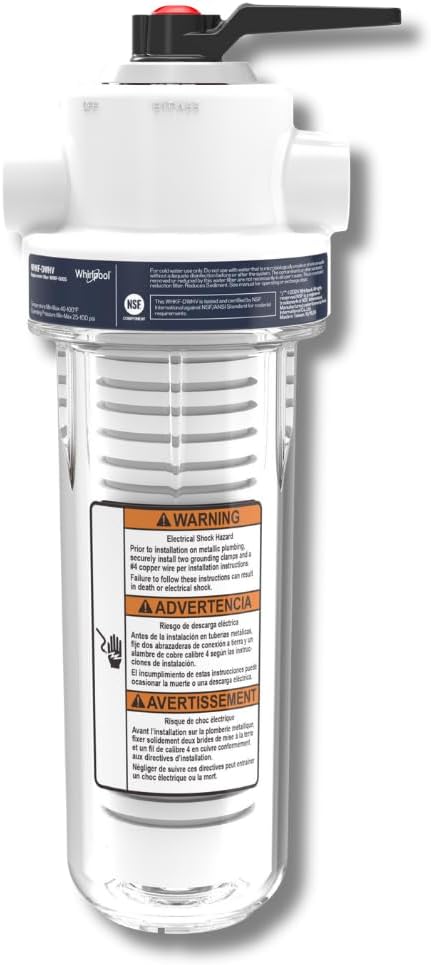
The CF1's catalytic carbon media is excellent at chlorine, chloramine, VOCs, and taste/odor reduction, but it will channel and short-cycle if loaded with fine sediment, iron flakes, or manganese precipitate. Most earthbag and cob homes are off-grid or on private wells, so a sediment pre-filter ahead of the CF1 is non-negotiable. Below are four pre-filter and complementary systems that pair well with the CF1 in 2026.
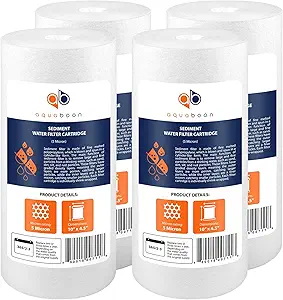
Aquaboon 5 Micron 10x4.5 Well Water Sediment Filter (4-Pack)
If your CF1 already has a single 10x4.5 sediment housing ahead of it, these replacement cartridges are the most economical way to keep the carbon bed clean. A four-pack typically gives a year of service on moderately silty well water. The 5-micron pleated polypropylene handles fine sand and rust flakes without choking flow at the CF1's 9 GPM rated throughput. View on Amazon
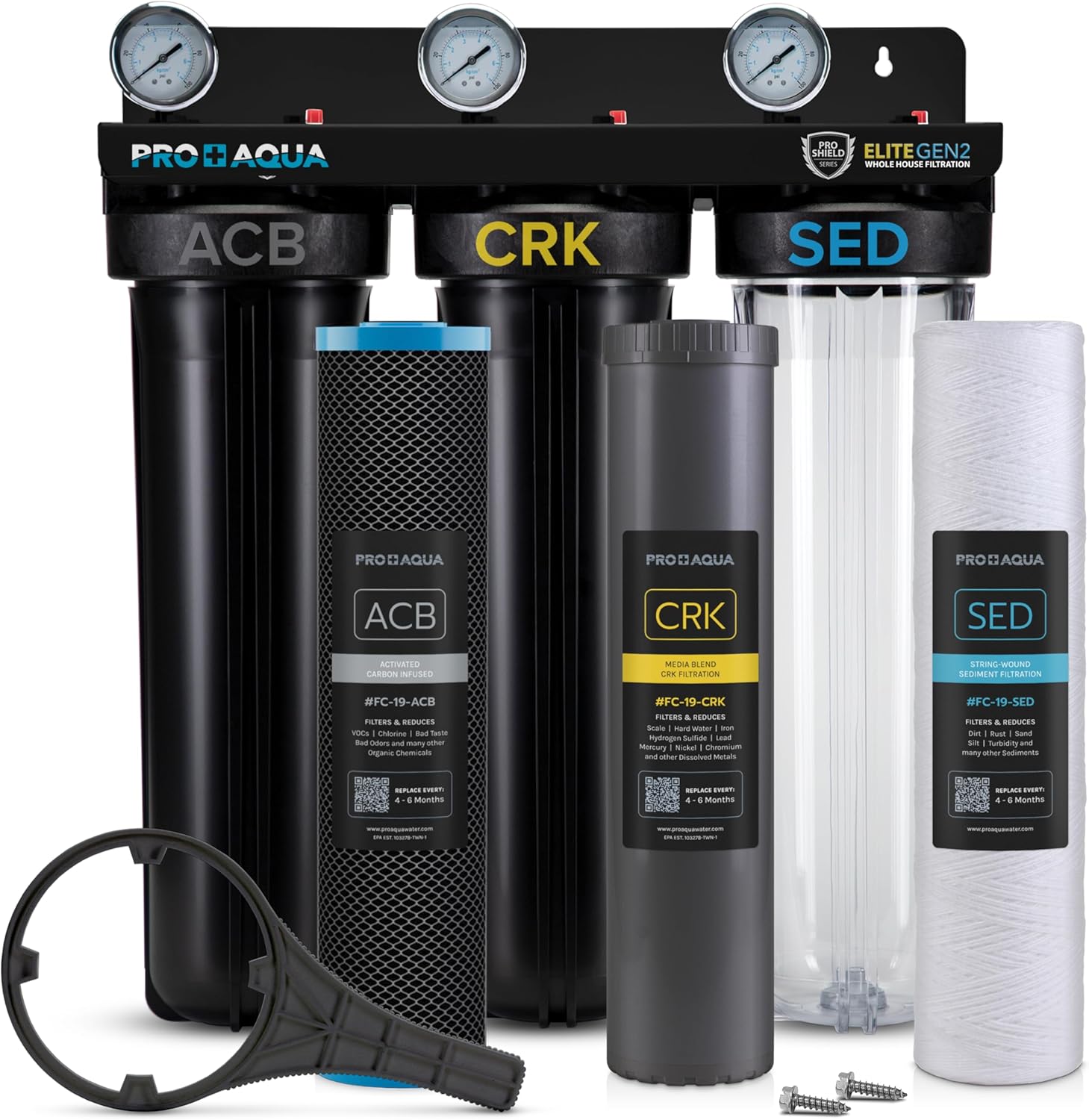
Express Water 3-Stage Whole House Water Filter System
For owner-builders who didn't add a sediment housing during rough-in, a three-stage cartridge bank gives you sediment, KDF, and carbon block stages in one wall-mounted unit. Mount it to the manifold board ahead of the CF1 and you have layered defense — the CF1 then polishes taste and chloramine while this unit handles bulk sediment and rust. Pressure drop is reasonable up to about 12 GPM. View on Amazon

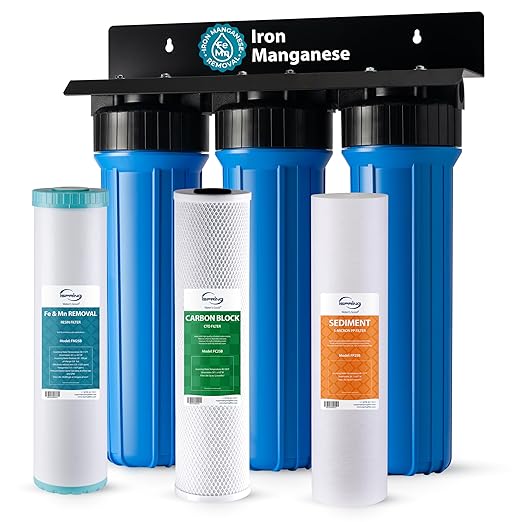
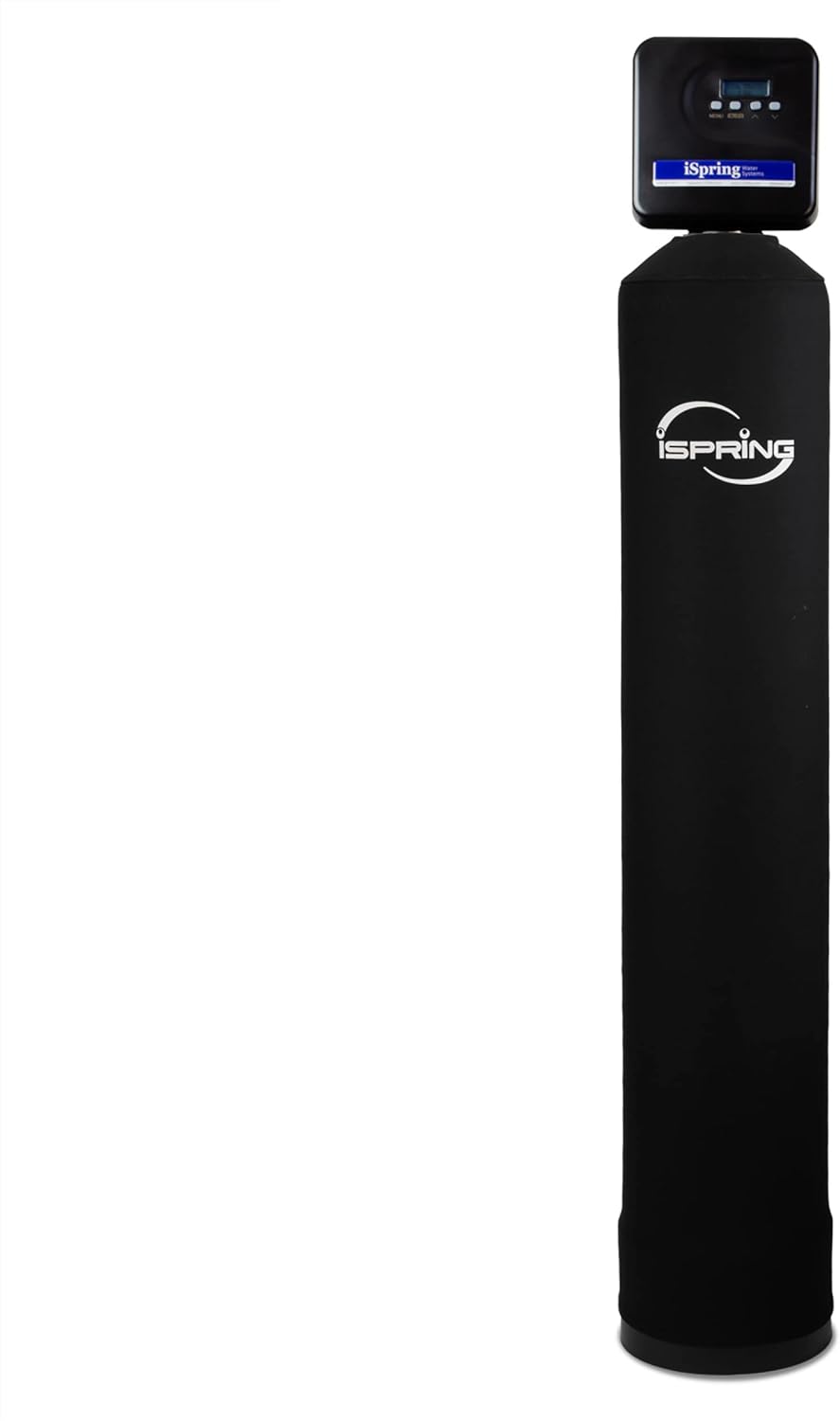
iSpring Iron & Manganese Whole House Water Filtration System
If your well draws from a formation high in iron (above 0.3 ppm) or manganese, the catalytic carbon in the CF1 will foul prematurely. The iSpring iron and manganese system uses a Greensand-style oxidizing media to drop these metals out before they reach your CF1, extending media life by years. It does require a small drain line for periodic backwash, which is easy to route through an earthbag wall sleeve. View on Amazon
HQUA WF3-01 3-Stage Whole House Water Filtration System
A budget-friendly three-stage alternative to the Express Water unit, the HQUA WF3-01 works well for cabins and smaller earthbag homes with one or two bathrooms. The sediment, GAC, and carbon block stages match the CF1's capacity nicely without overspending. View on Amazon
Aquasana Whole House Well Water Filter, 500K Gallons, UV+Carbon+KDF
If you are not yet committed to the CF1 and want a single integrated system that includes UV disinfection for a shallow well or spring source, the Aquasana 500K combines sediment, carbon, KDF, and UV in one stack. Some owner-builders use this instead of the CF1; others add UV downstream of the CF1 for microbiological assurance. View on Amazon
Pre-Filter Comparison Table
| System | Best For | Stages | Backwash Needed | Fits Earthbag Alcove |
|---|---|---|---|---|
| Aquaboon 5 Micron 4-Pack | Annual cartridge refills | Cartridge only | No | Yes |
| Express Water 3-Stage | Layered defense pre-CF1 | 3 | No | Yes |
| iSpring Iron & Manganese | High-iron wells | 1 (tank) | Yes | Needs drain sleeve |
| HQUA WF3-01 | Small cabin or 1-bath home | 3 | No | Yes |
| Aquasana 500K UV+KDF | Standalone or post-UV polish | 4 + UV | No | Larger footprint |
Cold-Weather and Thermal-Mass Considerations
Earthen walls are slow to change temperature, which is usually an asset — but in an unheated mechanical nook in a high-desert climate, the interior surface of an earthbag wall can drop to 38°F in January even when the main living space stays at 65°F. The CF1's tank is freeze-tolerant only down to about 40°F flowing water. For homes in USDA zones 5 and colder, wrap the tank in a 1-inch reflective foam jacket and add a small thermostatic outlet (set to 45°F) feeding a 60-watt incandescent rough-service bulb in a metal cage mounted on the manifold board. This is the same trick people use in well houses and we detail it in our off-grid cabin filter guide.
Commissioning and First-Flush
Once everything is plumbed, open the bypass to send house water around the CF1, then slowly crack the inlet valve on the tank with a hose run to a graywater outlet outside the earthbag wall. The first 10 to 15 minutes will produce carbon-fine-stained water — this is normal media dust. Do not send it through your home plumbing where it can stain unsealed cob plasters or earthen floors. Once the water runs clear, close the bypass and put the CF1 into service. Check all sleeve penetrations 24 hours later for any seepage; tighten and re-seal with elastomeric sealant as needed.
Long-Term Maintenance in an Earthen Home
Plan to replace any cartridge pre-filters every 6 to 12 months, inspect the CF1's bypass valve gaskets annually, and budget for full media replacement around year 8 to 10. Keep a service log near the manifold board — humidity in earthen homes can erase pencil marks on the tank label faster than you'd expect, so a laminated card on a hook is the practical move. For sizing decisions on annual cartridges, see our sediment pre-filter sizing guide.
Frequently Asked Questions
Can I mount the CF1 tank directly to a cob wall?
No. Cob and earthbag walls move seasonally as moisture content cycles, and the tank's weight plus plumbing torque will eventually crack the plaster or pull anchors loose. Always set the CF1 on an independent concrete or stabilized-adobe pad with at least a half-inch isolation gap from the wall.
How do I run plumbing through a 20-inch earthbag wall without compromising structural integrity?
Install a 2-inch PVC or HDPE sleeve through the wall at the rough-in stage, ideally between barbed-wire courses. For retrofits, core-drill with a diamond bit and water cooling. Run your supply line through the sleeve with foam backer rod and flexible elastomeric sealant at both faces — this preserves wall integrity and accommodates seasonal movement.
Does the Springwell CF1 work with a low-pressure off-grid well pump?
The CF1 is rated for 25 to 80 psi static pressure. If your off-grid pressure tank delivers below 40 psi, you may see reduced flow but the system will still function correctly. Most owner-builders pair it with a 30/50 psi pressure switch and a properly sized bladder tank for best results.
Do I need a water softener if I install the CF1 in an earthbag home?
The CF1 does not soften water — it removes chlorine, chloramines, VOCs, and taste/odor compounds. If your well tests above 7 grains per gallon of hardness, add a downstream softener or a salt-free conditioner. Many alternative builders prefer salt-free for environmental and graywater-reuse reasons.
Can I install the CF1 outdoors in a covered well house instead of inside the earthbag home?
Yes, if the well house stays above 40°F year-round and is shaded from direct sun. UV degrades the tank's outer fiberglass wrap over a decade, and freezing will rupture the media bed. Most builders prefer interior installation specifically to leverage the earthen wall's thermal stability.
How long does it take to install a CF1 in a finished cob home?
A retrofit installation with core-drilling, pad pouring, manifold board, bypass plumbing, and sediment pre-filter typically runs 12 to 16 hours of working time over two or three days, including pad cure time. New construction with rough-in sleeves already in place can be commissioned in 4 to 6 hours.
What sediment micron rating should I use ahead of the CF1?
Five microns is the sweet spot for most well water feeding a CF1. Tighter (1 micron) drops too much pressure for typical off-grid pumps; looser (20 micron) lets fine silt reach the carbon bed and cause channeling. A 5-micron pleated polypropylene cartridge — like the Aquaboon 4-pack — is the standard choice in 2026 owner-builder communities.
Key Takeaways
- Choosing the right install springwell cf1 in earthbag cob wall homes means matching capacity and output ports to your actual devices
- Always check actual watt-hours (Wh), not just watts — runtime depends on Wh, not peak output
- Also covers: springwell cf1 install natural building homes
- Also covers: earthbag home water filter installation springwell
- Also covers: cob wall plumbing penetration springwell cf1
- Compare price-per-Wh across models to find the best value for your budget