If you share a well pump house with neighbors or outbuildings, the pelican pse1800 install shared well pump house question comes down to three things: where to tap into the supply line without starving other users, how to protect the PSE1800 cartridge from sediment surges caused by multiple pumps cycling, and how to keep the bypass loop accessible for everyone who depends on that water. The Pelican PSE1800 is a salt-free conditioner plus carbon filter designed for homes up to six bathrooms, but in a shared pump house it must be installed downstream of the pressure tank, after the common manifold, and on your private branch line only—never on the shared trunk feeding other dwellings. Add a 5-micron sediment pre-filter and, if your well shows iron above 0.3 ppm, a dedicated iron stage before the PSE1800 inlet.
Why shared well pump houses need a different install approach
A standard single-family PSE1800 install assumes one pressure tank, one main line, and one homeowner making decisions about shutoffs. A shared pump house flips all three assumptions. You may have a 1.5 HP submersible pump feeding a 119-gallon bladder tank that supplies two or three homes through a buried manifold. Pressure cycles when neighbors draw water, sediment gets stirred up every time the pump kicks on, and any shutoff you install affects only your branch—not the shared header. Before you touch a pipe, walk the pump house with the other owners and document who owns which valve. The PSE1800 needs 25-80 psi inlet pressure and a minimum 3/4" supply, and in a shared setup the pressure can sag well below 25 psi during peak draw if you tap too close to the pump.
Step-by-step: pelican pse1800 install shared well pump house plumbing
The cleanest pelican pse1800 install shared well pump house sequence keeps the unit out of the pump house entirely and places it where your branch line enters your home. This gives you exclusive control, simplifies winterization for your unit alone, and avoids HOA disputes about shared equipment. Here is the order of operations that has worked best for well owners on co-shared systems.
- Identify the demarcation point. This is where the shared manifold ends and your private service line begins—usually a curb stop or shutoff valve at the property line or where the line enters your crawlspace.
- Install an isolation ball valve on your branch immediately after the demarcation. This becomes your master shutoff for the PSE1800 and any future softener.
- Add a sediment pre-filter housing rated 5 microns. Shared pump cycling stirs up far more sand and clay than a single-home system, and the PSE1800 carbon bed will channel within a year if you skip this.
- Install iron removal if needed. Test for iron, manganese, and hydrogen sulfide before you commit. A salt-free conditioner like the PSE1800 does not remove iron, and dissolved iron will foul the carbon and any downstream softener resin.
- Plumb the PSE1800 bypass loop with three valves: inlet, outlet, and bypass. The kit ships with one, but in shared setups you want full-port brass, not the plastic version, because you may need to isolate the unit when neighbors drain the system for repairs.
- Anchor and support the tank. The PSE1800 weighs over 80 lbs full. In a crawlspace or basement near the entry point, set it on a polyethylene drain pan and strap the head to a stud.
- Slow-fill and flush. Open the inlet 1/4 turn first to bleed air, then flush 10-15 minutes to clear carbon fines before the line goes to fixtures.
Pre-filter picks that protect the PSE1800 on a shared well
The single biggest predictor of PSE1800 lifespan in a shared pump house is sediment load. Every time another home on the manifold draws water, your branch sees a small pressure drop followed by a turbulent refill that pulls sand off the well casing and clay off the tank diaphragm. A dedicated pre-filter stage is non-negotiable.
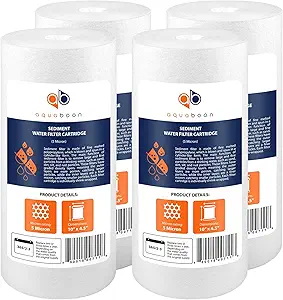
Aquaboon 5 Micron 10x4.5 Well Water Sediment Filter (4-Pack)
These are the standard big-blue replacement cartridges that fit any 10x4.5 housing, and a 4-pack gives you a full year of changes at quarterly intervals—the cadence I recommend for any shared-pump-house install. The 5-micron rating is the sweet spot: tight enough to protect the PSE1800 carbon, loose enough not to crash your pressure during peak draw. Check the Aquaboon 4-pack on Amazon.
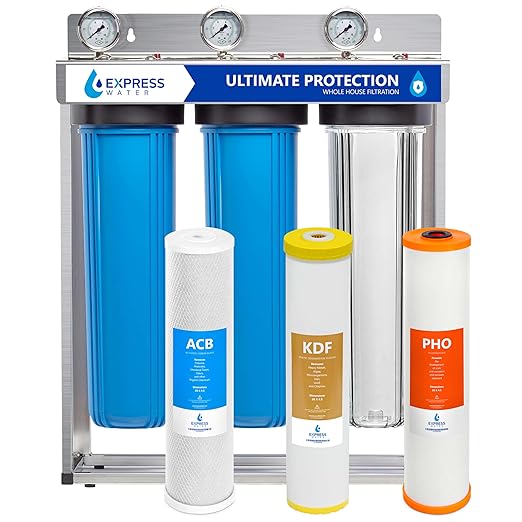
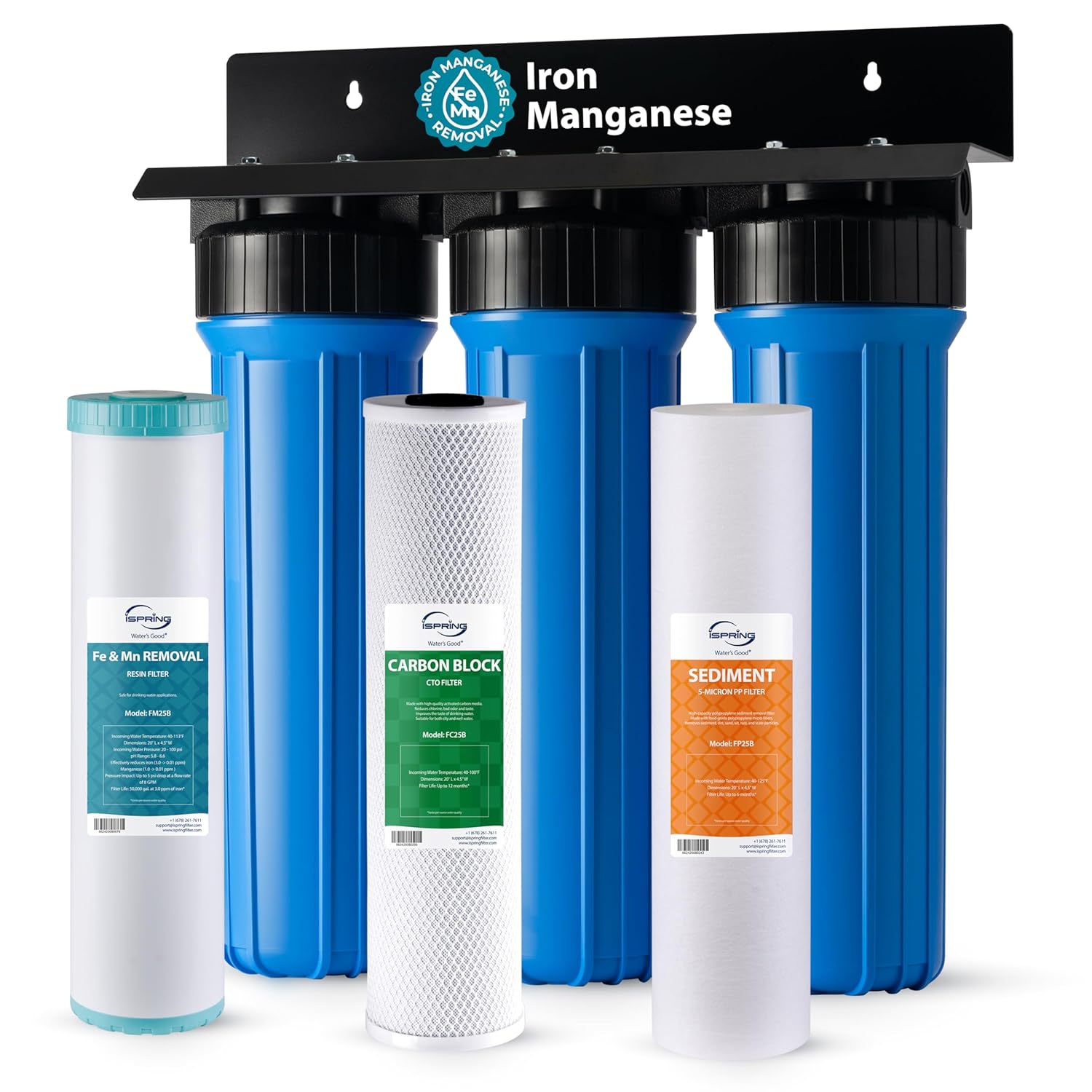
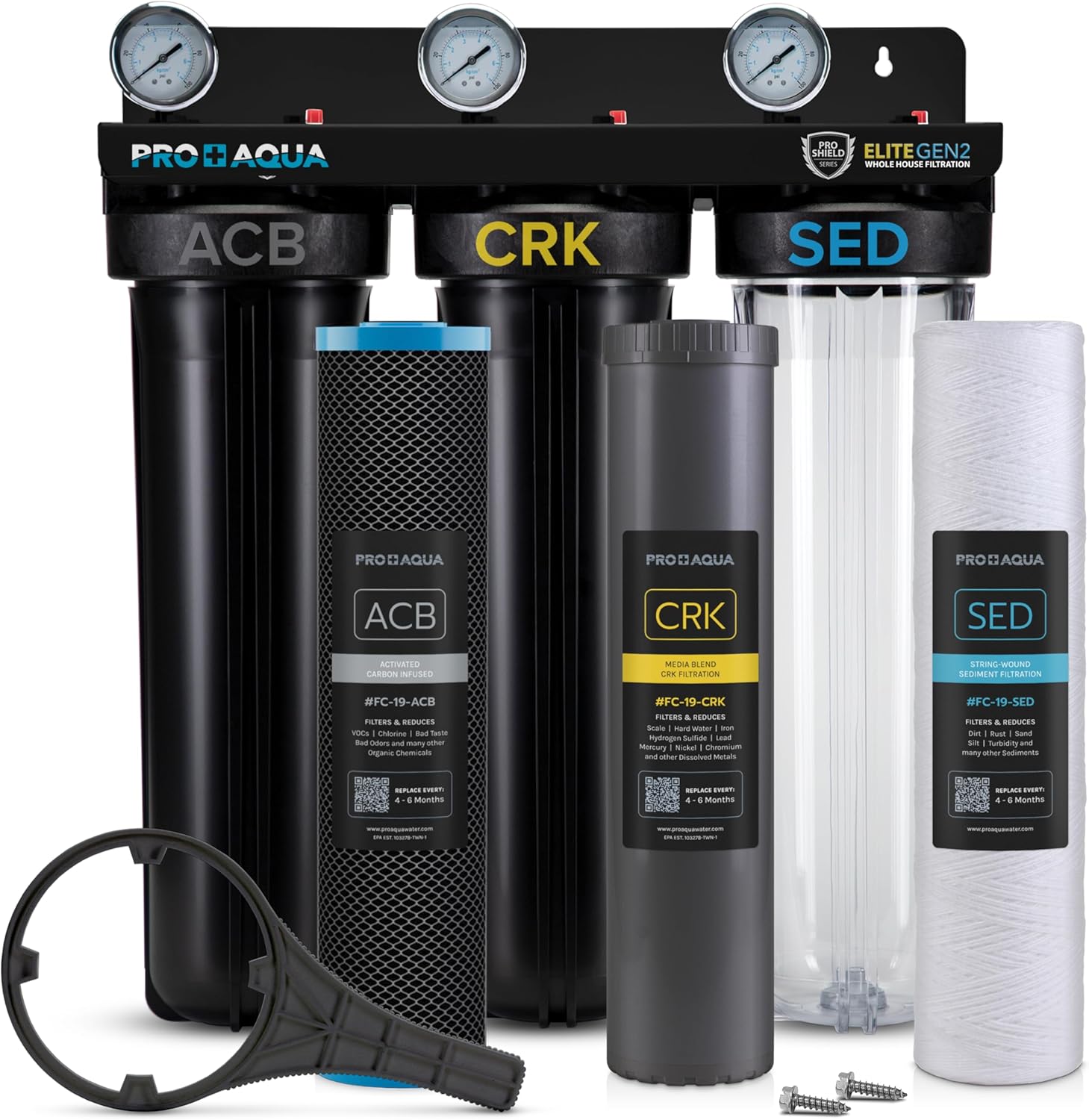
Express Water 3-Stage Whole House Water Filter System
If you don't already own a big-blue housing, this 3-stage kit gives you sediment, KDF, and carbon in one frame for less than buying empty housings separately. Mount it on the wall ahead of your PSE1800 and you essentially double the conditioner's service life. The pressure gauges on each stage are the feature shared-well owners appreciate most—you can see at a glance when neighbors are drawing heavy and your sediment stage is loading up. View the Express Water 3-stage on Amazon.
HQUA WF3-01 3-Stage Whole House Water Filtration System
A budget alternative to the Express Water with the same big-blue form factor. The HQUA WF3-01 ships with a sediment, GAC, and carbon block stack that handles most shared-well chemistry as long as iron stays low. Cartridge replacements are inexpensive and widely available. See the HQUA WF3-01 on Amazon.
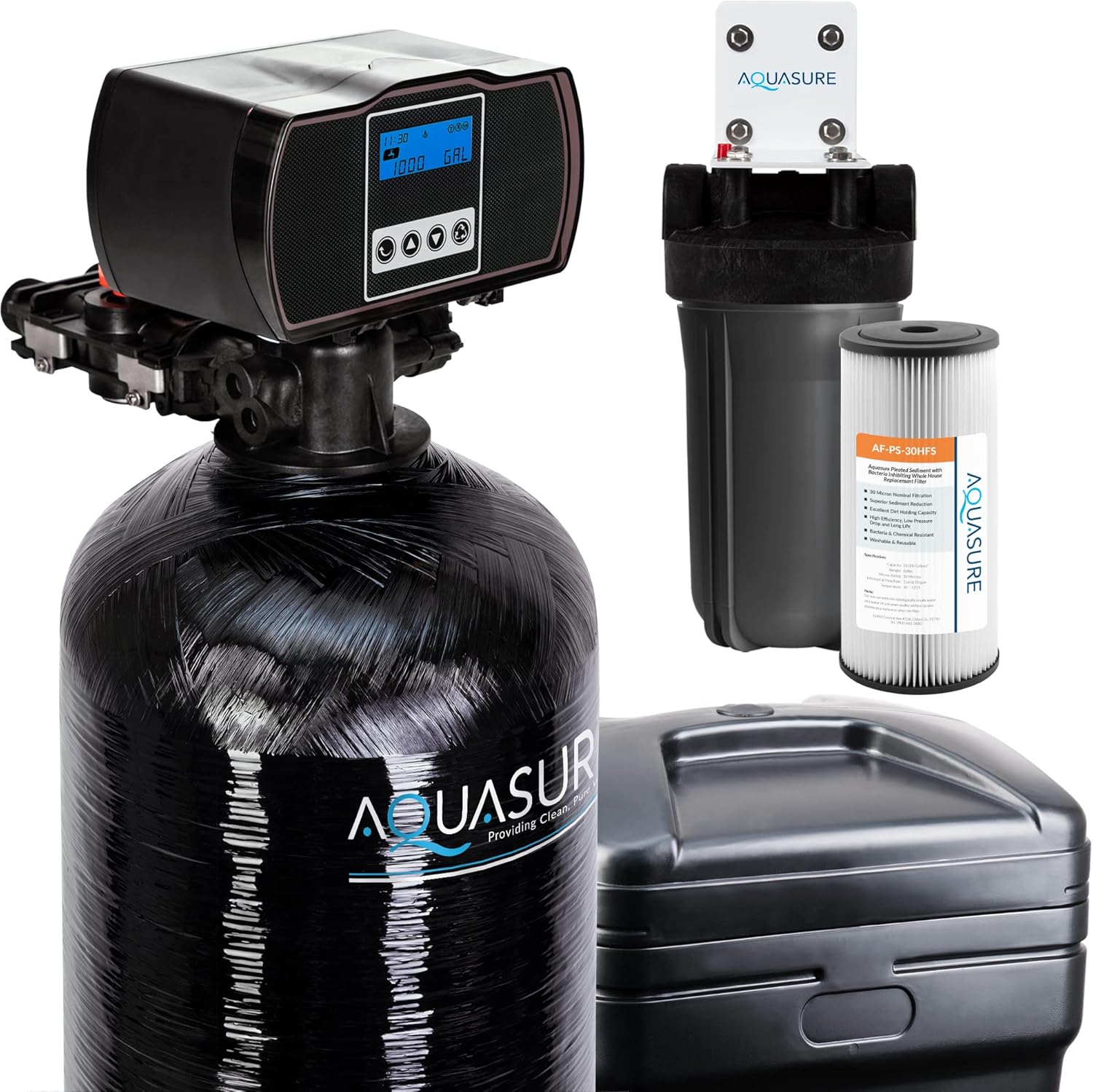
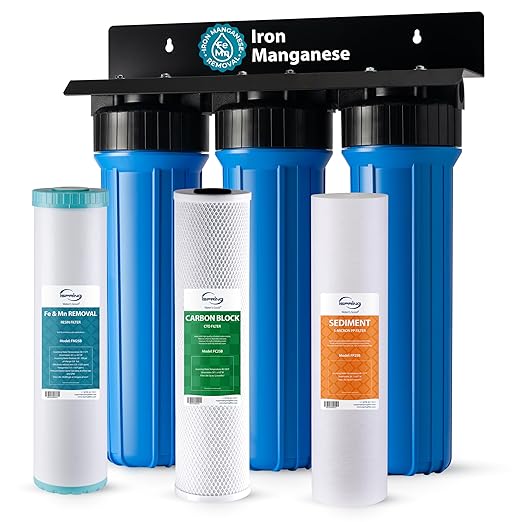
iSpring Iron & Manganese Whole House Water Filtration System
If your test strip shows iron above 0.3 ppm or any orange staining on porcelain, install this iron stage between the sediment pre-filter and the PSE1800. The PSE1800's catalytic carbon will be destroyed by ferrous iron within months, and an iron-removal stage costs less than one PSE1800 cartridge replacement. Check the iSpring iron filter on Amazon.
Aquasana Whole House Well Water Filter, 500K Gallons
If you are still on the fence about the PSE1800 itself, the Aquasana 500K gallon well filter is the closest direct competitor: UV plus carbon plus KDF in one stack. Some shared-pump-house owners actually pick the Aquasana over the PSE1800 because UV gives them a bacterial safety margin when neighbors' septic systems are nearby. View the Aquasana well filter on Amazon.
Comparison: pre-filter and complementary systems for shared wells
| System | Stages | Best Role with PSE1800 | Approx. Capacity |
|---|---|---|---|
| Aquaboon 5 Micron 4-Pack | Sediment cartridges only | Replacement cartridges for big-blue pre-filter | ~3 months each |
| Express Water 3-Stage | Sediment + KDF + Carbon | Full pre-filter assembly upstream of PSE1800 | ~100,000 gal |
| HQUA WF3-01 3-Stage | Sediment + GAC + Carbon | Budget pre-filter assembly | ~100,000 gal |
| iSpring Iron & Manganese | Iron + Manganese removal | Dedicated iron stage before PSE1800 | ~1 year media |
| Aquasana 500K Well Filter | UV + Carbon + KDF | Direct PSE1800 alternative with UV | 500,000 gal |
Sizing, pressure, and the shared manifold
The PSE1800 is rated for service flow up to 15 gpm and recovery of 18 gpm. On a single-family install that is comfortable. On a shared manifold feeding two or three homes off a 1.5 HP pump, your branch may only see 6-9 gpm during peak draw when neighbors are also running. Measure your actual delivered flow at the closest hose bib before you order—fill a 5-gallon bucket and time it. If you're seeing under 6 gpm during the worst-case scenario (everyone showering), the PSE1800 is still appropriate, but you'll want to mount the bypass with full-port valves so you can switch around the unit when guests visit and demand spikes.
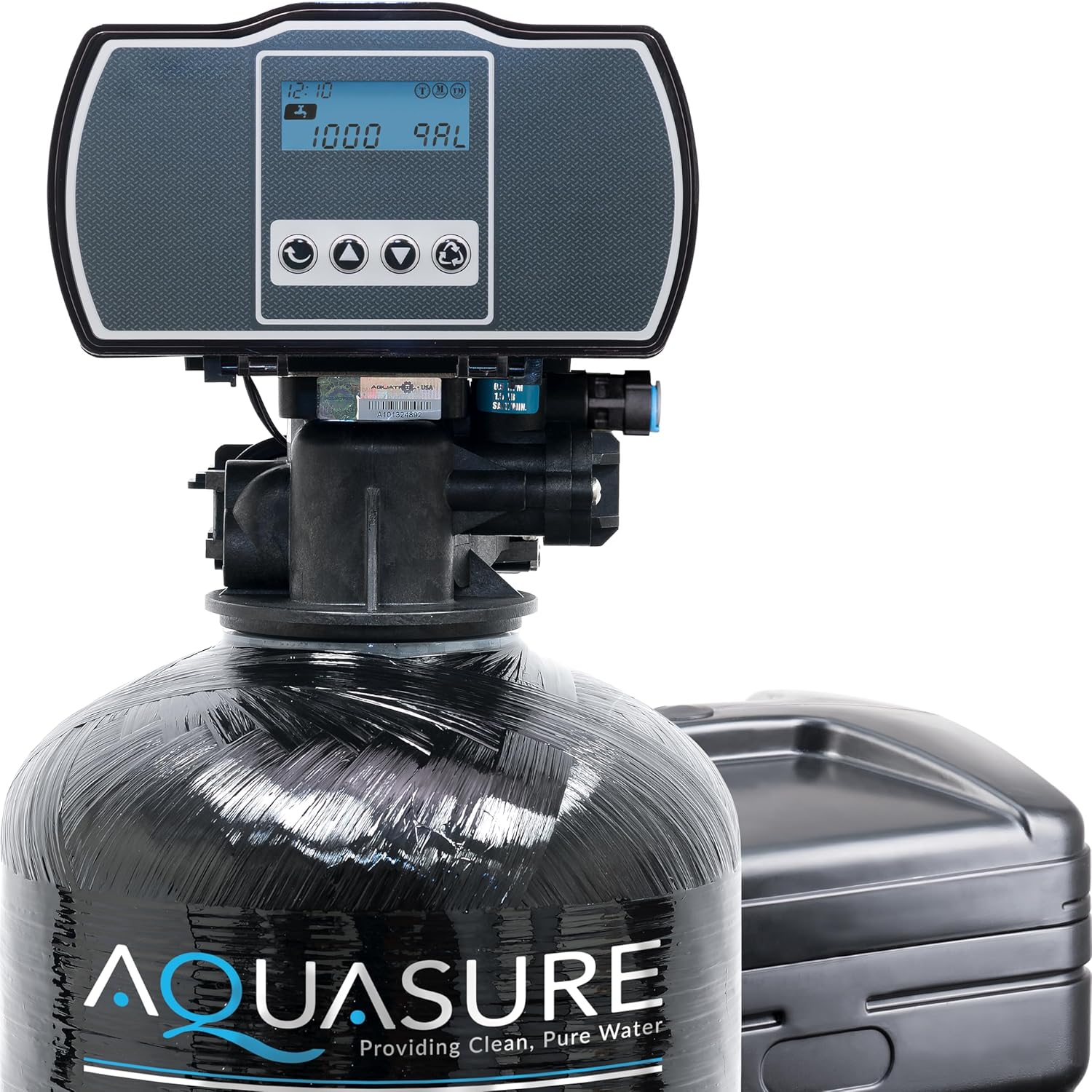
Static pressure matters as much as flow. Most shared pump houses run a pressure switch at 40/60 psi. The PSE1800 needs at least 25 psi to function, which sounds fine until you remember that adding a sediment pre-filter and an iron stage upstream costs you about 4-7 psi each at full flow. Stack three pre-filters and you can drop from 40 psi static to under 20 psi dynamic at the PSE1800 inlet. Solution: ask the pump house association to bump the pressure switch to 50/70 psi if the pressure tank and pump are rated for it, or install a small inline booster pump on your branch only.
HOA, easement, and shutoff etiquette
Many shared pump house arrangements are governed by a recorded water-sharing agreement or HOA covenant. Before you start cutting pipe, read the document. Some agreements specifically prohibit homeowners from installing any equipment that could affect pressure or flow to other parties—and a salt-free conditioner technically does both, even if slightly. The safest install path is to keep all your equipment on your side of the demarcation point, document the install with photos, and notify your co-owners in writing before you start. If you must enter the pump house to tap a manifold port, schedule the work during a time when no one needs water and coordinate the shutoff. For more on coordinating shared-system upgrades, see our guide on sizing pressure tanks for shared wells and the companion piece on building a bypass loop that survives neighbor disputes.
Winterization and seasonal considerations
If your shared pump house is in a cold climate, the PSE1800 must be installed where it cannot freeze. Carbon tanks expand when frozen and the FRP shell can crack, voiding the warranty. Most owners place the PSE1800 inside the home near the entry point, not in the pump house itself. If you must locate it in an outbuilding, insulate the tank with a 1" closed-cell wrap, heat-trace the inlet and outlet pipes, and install a low-temp alarm. For shared-well owners who shut down seasonally, drain the PSE1800 by closing the inlet, opening the outlet, and removing the drain plug at the base—then leave the bypass open so the system can be flushed when you return. The salt-free conditioner vs. softener comparison covers winterization differences in more detail.
Frequently Asked Questions
Can I install a Pelican PSE1800 inside a shared well pump house?
Technically yes, but it's strongly discouraged. The pump house is shared infrastructure, and any equipment you place there can be touched, drained, or bypassed by other owners. Install the PSE1800 on your private branch line where it enters your home so you retain full control of the unit and the bypass loop.
Does the PSE1800 reduce flow or pressure for neighbors on the same well?
No—as long as you install it on your branch line downstream of the demarcation point. The PSE1800 only affects water flowing through your service line. If you mistakenly install it on the shared trunk before the manifold, every neighbor's flow drops by the unit's pressure loss (about 4-6 psi at full flow).
What sediment pre-filter rating works best for shared well water?
A 5-micron big-blue cartridge is the sweet spot. Shared pump houses see more sediment surges than single-family wells because every pump cycle stirs up sand. Tighter ratings (1 micron) clog within weeks; looser ratings (20 micron) let fines through that damage the PSE1800 carbon bed. Plan on quarterly cartridge changes.
Do I need a softener as well as the PSE1800 in a shared well setup?
Only if your hardness exceeds 25 grains per gallon or you want spot-free dishes. The PSE1800 is a conditioner, not a softener—it changes how calcium behaves but does not remove it. For shared wells with hard water, install a dedicated softener downstream of the PSE1800 on your branch only, never on the shared trunk.
How do I handle the PSE1800 bypass during a shared pump shutdown?
Close your branch isolation valve first, then open the PSE1800 bypass and close the inlet and outlet. This isolates your filtration completely so the shared pump can be serviced without draining your unit. When water returns, flush 5 minutes through the bypass before opening the inlet to clear any debris stirred up by the repair.

Is iron removal necessary before the PSE1800 on a well?
Yes, if your iron level exceeds 0.3 ppm or you see orange staining. Ferrous iron foul the PSE1800 catalytic carbon within months and is not covered under warranty. A dedicated iron stage like the iSpring system upstream protects the conditioner and pays for itself in extended carbon life.
Can I install the PSE1800 myself or do I need a plumber?
A handy homeowner with PEX or copper skills can do it in a Saturday afternoon, but in a shared pump house arrangement you may need to coordinate with co-owners on shutoffs and HOA notification. If your water-sharing agreement requires licensed work or permits, hire a plumber. The actual plumbing is straightforward—it's the shared-system coordination that catches DIYers off guard.
Key Takeaways
- Choosing the right pelican pse1800 install shared well pump house means matching capacity and output ports to your actual devices
- Always check actual watt-hours (Wh), not just watts — runtime depends on Wh, not peak output
- Also covers: shared well softener install
- Also covers: pse1800 pump house plumbing
- Also covers: pelican combo shared well neighbors
- Compare price-per-Wh across models to find the best value for your budget