For a budget whole house water system tiny home 400 square feet owners can actually mount under a kitchen sink, in a utility closet, or beside a water heater, you want a compact 3-stage cartridge unit in the $150–$300 range. The Express Water 3-Stage and HQUA WF3-01 dominate this segment in 2026 because they fit a 22-inch vertical footprint, handle 15 GPM (far more than a tiny home's 2–4 GPM demand), and use universal 10"x4.5" cartridges available everywhere. Skip oversized 1,000,000-gallon tank systems unless you're on heavy well water with iron — those need 18+ inches of floor clearance you don't have.
Why Most "Whole House" Systems Don't Fit a Tiny Home
Standard whole house filtration was designed for 2,000+ sq ft houses with basements or garages. A typical tank-based system is 9–12 inches in diameter, 48–62 inches tall, and needs another 6 inches of overhead clearance to swap media. In a tiny home built on a 8.5x24 ft trailer or a 20x20 ft slab, you simply don't have that vertical run between the water inlet and the next plumbing fixture.
The fix is a wall-mounted cartridge system. These bolt to a stud, sit on a steel bracket, and use replaceable 10"x4.5" "Big Blue" cartridges. For a whole house water system tiny home 400 square feet applications specifically, the cartridge approach wins on three counts: footprint (under 8 inches deep), serviceability (twist the housing off without draining anything), and weight (a full system runs 25–35 lbs vs. 80+ lbs for a tank, which matters if your tiny home is on wheels and subject to DOT axle limits).
If you're new to filtration sizing, our whole house filter sizing guide covers GPM and pressure-drop math in more detail.
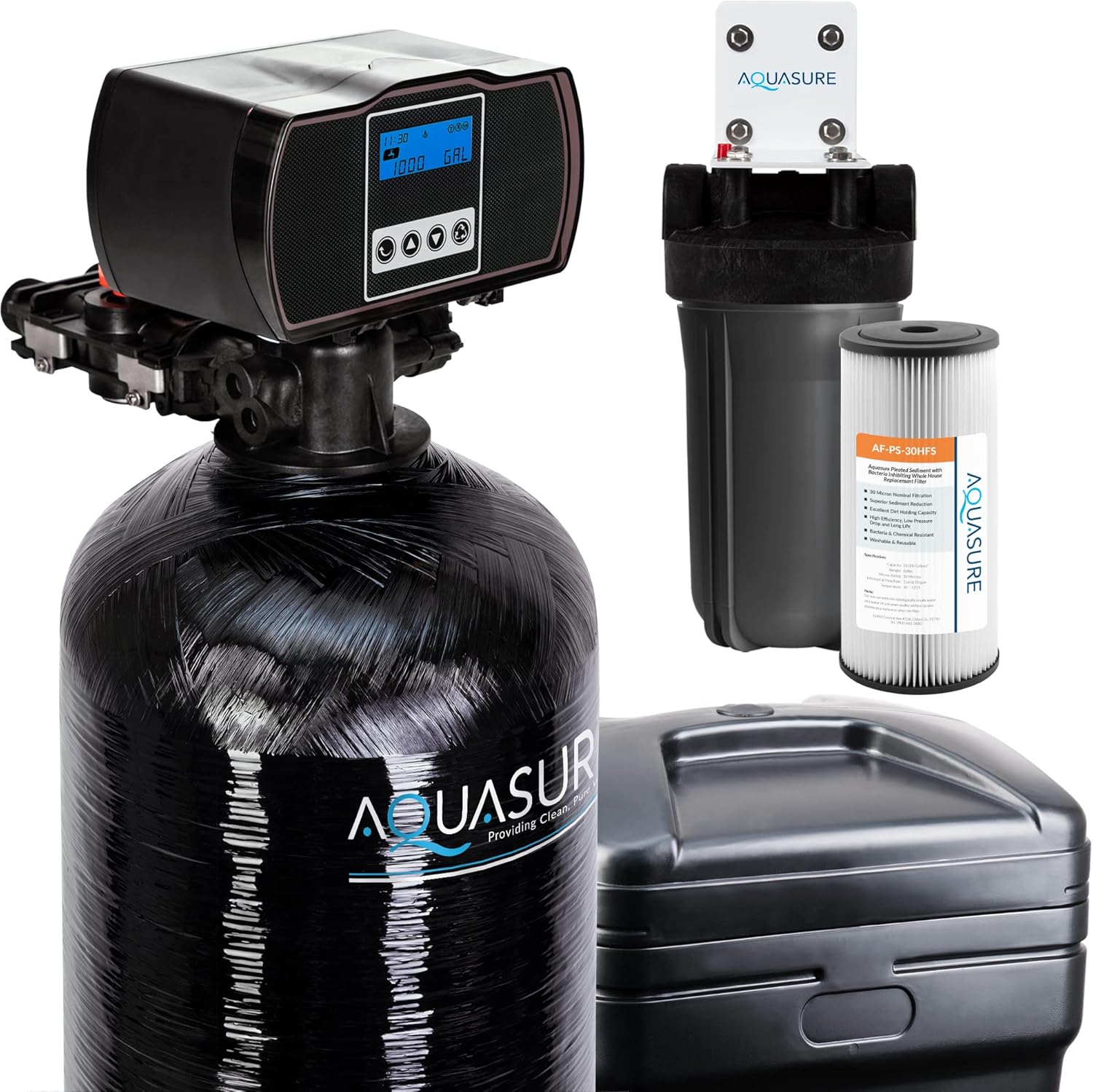
2026 Comparison: Budget Whole House Picks for Tiny Homes
| System | Footprint | Stages | Flow Rate | Best For | Price Tier |
|---|---|---|---|---|---|
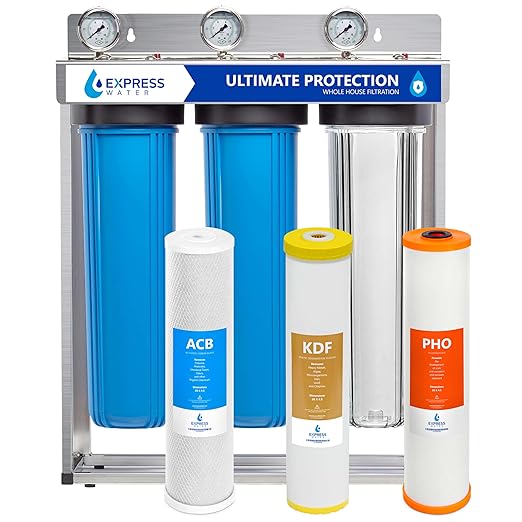
| Express Water 3-Stage | 22"W x 25"H x 8"D | Sediment + KDF + Carbon | 15 GPM | City water, most tiny homes | $$ |
| HQUA WF3-01 | 21"W x 24"H x 7"D | Sediment + GAC + Carbon Block | 15 GPM | Tightest budgets | $ |
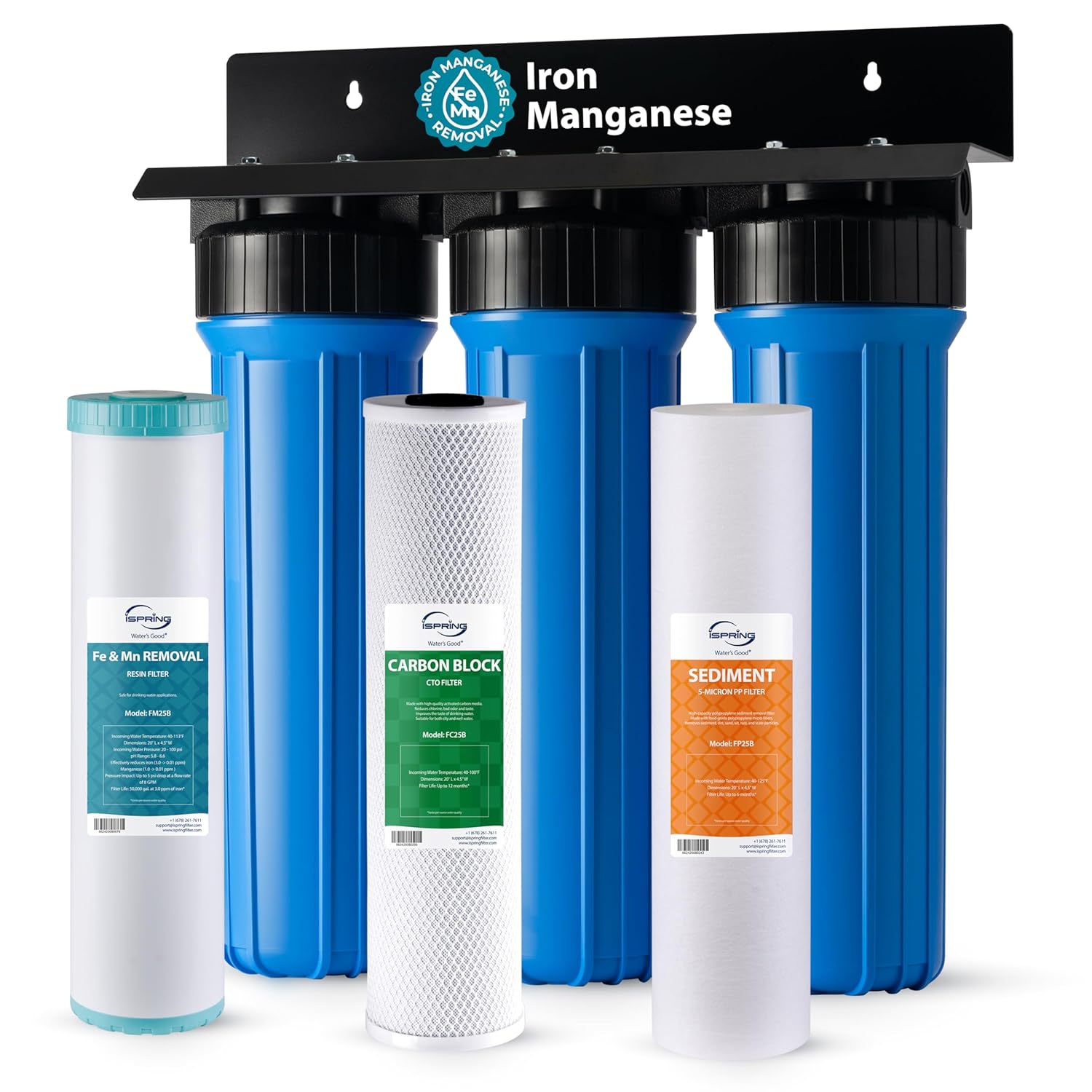
| iSpring Iron & Manganese | 24"W x 28"H x 9"D | Sediment + Iron/Mn + Carbon | 15 GPM | Well water with rust staining | $$ |
| Aquasana 500K UV+KDF | 30"W x 60"H x 12"D | Sediment + UV + Carbon + KDF | 7 GPM | Off-grid well + pathogens | $$$$ |
| Aquaboon Sediment (4-pack) | N/A (cartridge) | 5 micron sediment | — | Replacement cartridges | $ |
Top Budget Whole House Picks for 400 Sq Ft Builds
Best Overall: Express Water 3-Stage Whole House Water Filter System
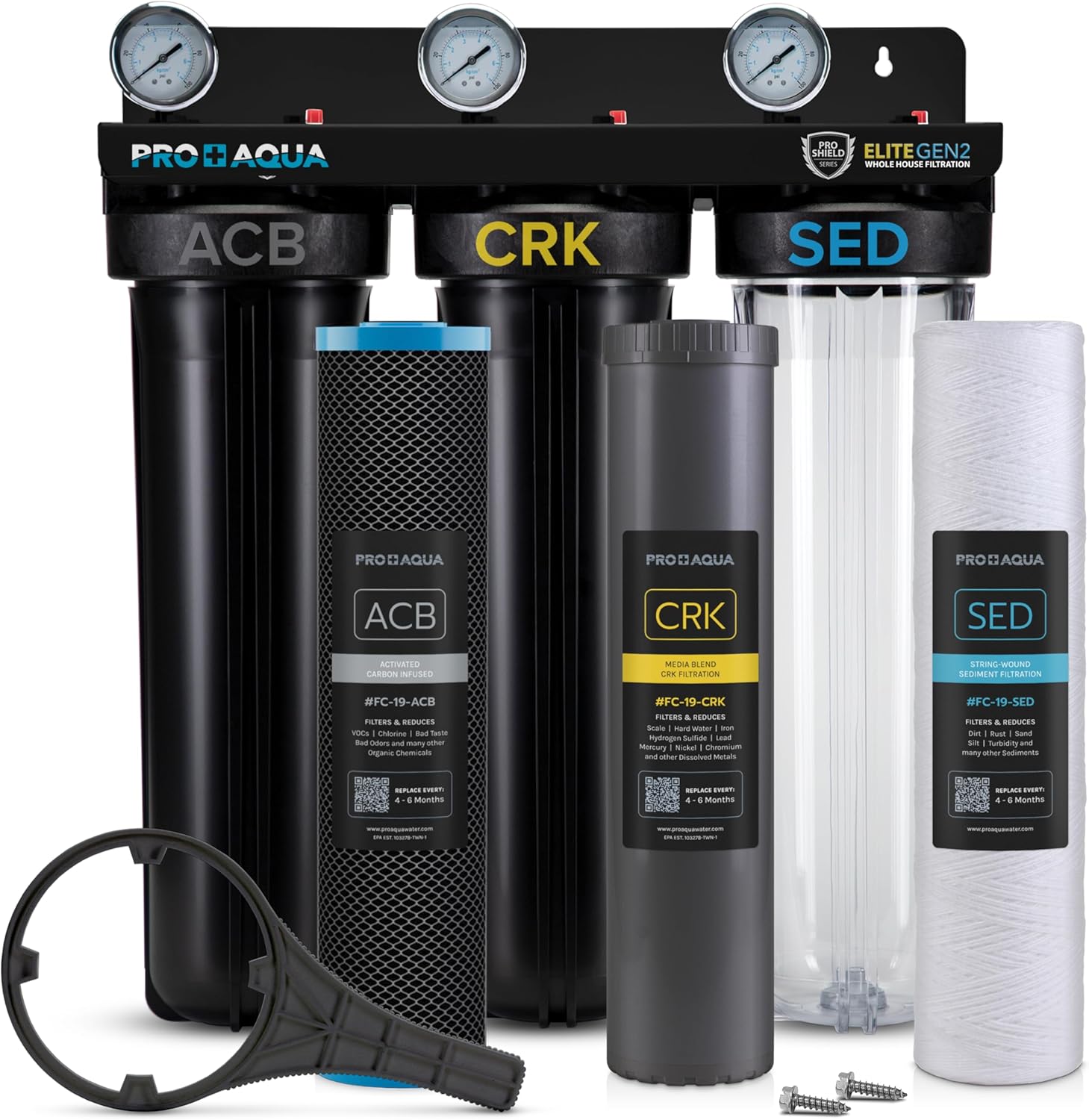
This is the system I recommend by default for any tiny home on city water, RV park hookups, or a clean residential well. The 22-inch horizontal manifold mounts flat against a 16" stud-spaced wall, leaving room for a pressure gauge between each stage so you can see exactly when a cartridge is loading up. Stage 1 is a 5-micron sediment filter that catches the sand and rust flakes that tear up tankless water heaters; stage 2 is KDF + carbon, which strips chlorine and the heavy metals (lead, mercury) that show up in older municipal lines; stage 3 is a polishing carbon block for taste. At 15 GPM rated flow, it has roughly 5x the headroom a tiny home shower + toilet + kitchen sink will ever pull simultaneously, which means near-zero pressure drop. Cartridges last 6–12 months depending on incoming water. Check the Express Water 3-Stage on Amazon.
Cheapest Complete System: HQUA WF3-01 3-Stage Whole House Water Filtration System
If your tiny home budget for water filtration is $150 and not a penny more, the HQUA WF3-01 is the system to grab. It uses the same 10"x4.5" Big Blue cartridge standard as Express Water, so replacement filters are commodity items — you're not locked into a proprietary cartridge ecosystem. The housings are slightly thinner-walled than Express Water's (which is the main reason it's cheaper), but for the 50–70 PSI pressures most tiny homes run, that's a non-issue. Stages are sediment, granular activated carbon, then a 5-micron carbon block. The included wrench, mounting bracket, and pressure-release buttons cover everything you need to install in under two hours. Check the HQUA WF3-01 on Amazon.
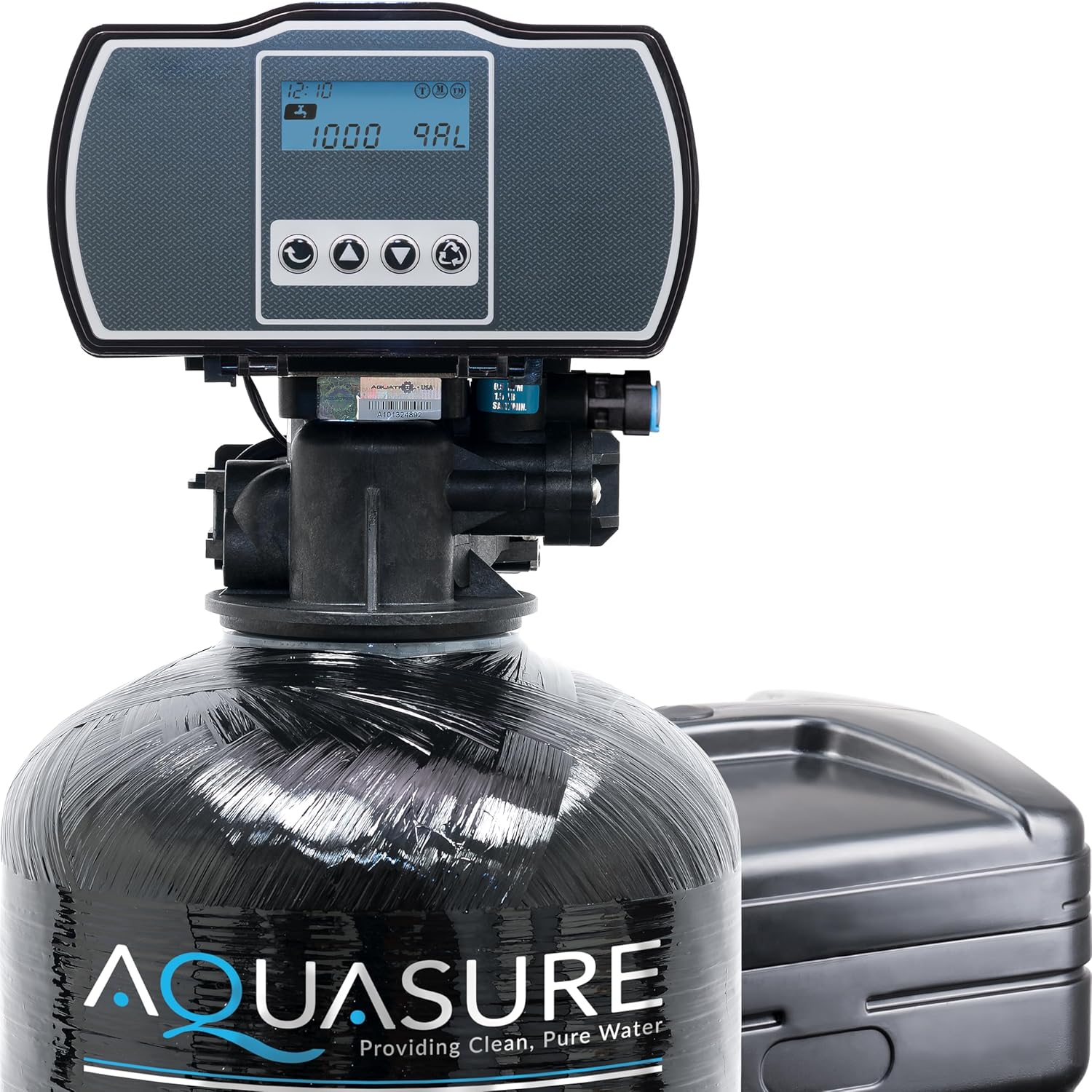
Best for Well Water: iSpring Iron & Manganese Whole House Water Filtration System
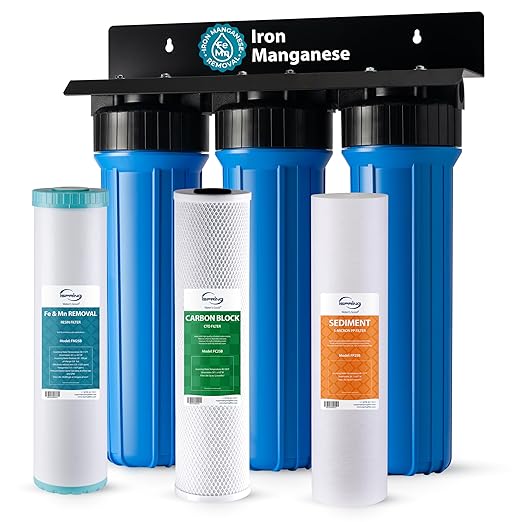
Tiny homes on rural land almost always pull from a private well, and private wells in much of the US and Canada carry dissolved iron and manganese that rapidly stain fixtures, ruin laundry, and clog low-flow aerators. The iSpring Iron & Manganese system uses a specialized oxidizing media bed to drop iron out of solution before it ever reaches your faucets. It's slightly deeper than the basic 3-stage units (9" vs 7–8"), but if you have rust-colored staining in your toilet bowl or a metallic taste in cold water, no amount of sediment + carbon filtration will fix it — you need this targeted media. Pair it with a basic sediment pre-filter and you have a complete well-water solution that still fits in a tiny home utility closet. Check the iSpring Iron & Manganese system on Amazon.
Off-Grid Splurge: Aquasana Whole House Well Water Filter 500K UV+Carbon+KDF
If your tiny home is fully off-grid on a shallow well, spring catchment, or surface water source, you need UV disinfection on top of mechanical and chemical filtration. The Aquasana 500K is the only system in this roundup that includes a UV chamber to kill bacteria, viruses, and protozoa. It's bigger than the cartridge systems — 60 inches tall — but the 500,000-gallon capacity means you're not changing media for years, and the UV bulb pulls just 40W (easily handled by a modest solar setup). This is overkill for city water tiny homes, but for a backwoods cabin build on a marginal water source, it's the right tool. Check the Aquasana 500K UV system on Amazon.
Essential Replacement: Aquaboon 5 Micron 10x4.5 Well Water Sediment Filter (4-Pack)
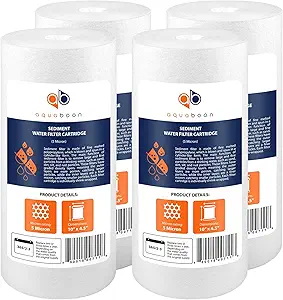
Whatever system you pick from the list above, you'll burn through stage-1 sediment cartridges faster than any other filter — especially on well water with seasonal silt. The Aquaboon 4-pack is the cheapest per-cartridge price I've found in 2026 for a quality melt-blown 5-micron cartridge that fits every Big Blue 10"x4.5" housing. Buying a 4-pack upfront means you have a year-plus of sediment changes on the shelf, and you won't be tempted to skip a change because you forgot to reorder. Check the Aquaboon 4-pack on Amazon.
Installation in a Tiny Home: What Actually Matters
Tiny home plumbing usually enters through the floor or a sidewall fitting in 1/2" or 3/4" PEX. Your filter system will have 1" NPT inlet and outlet ports, so plan on two PEX-to-1" NPT brass adapters and a short length of PEX to make the transition. Mount the bracket to studs — not paneling — at a height where you can reach the bottom of each housing with the included plastic wrench, typically 36–42 inches off the floor. Leave 8 inches of clearance below each housing so the cartridge can drop out for changes.
Install a bypass loop with three ball valves: one inlet shutoff, one outlet shutoff, and one bypass that connects inlet directly to outlet. This lets you isolate the filter for cartridge changes without losing water in the rest of the home. Total install time runs 2–4 hours for someone comfortable with PEX, and your water heater pairing guide covers downstream sizing considerations.
One detail that surprises tiny home builders: pressure drop. A new cartridge set will drop pressure by 2–3 PSI. By the time the sediment stage loads up, that can climb to 10–15 PSI. If your incoming pressure is already marginal (under 45 PSI from a well pump or RV pedestal), install a pressure gauge upstream of the system and plan to change cartridges aggressively. For RV park living, a low-cost pressure regulator on the inlet hose protects the filter housings from spikes.
Frequently Asked Questions
Do I really need a whole house system in a tiny home or will a faucet filter do?
A faucet filter only protects drinking water. A whole house system protects your tankless water heater, washing machine solenoid valve, shower mixing valve, and toilet fill valve from sediment and chlorine damage — all of which are expensive to replace and hard to access in a tiny home's tight plumbing chases. For long-term ownership of a tiny home, whole house is the cheaper choice over a 5-year horizon.
How much GPM does a 400 sq ft tiny home actually use?
Peak demand in a tiny home with one shower, one toilet, and one kitchen sink is 4–6 GPM if everything runs simultaneously. Realistic single-fixture demand is 1.5–2.5 GPM. The 15 GPM rating on the Express Water and HQUA systems gives you 3x headroom, so flow restriction will never be the bottleneck.
Can I install one of these systems on a tiny home on wheels?
Yes — cartridge systems are vibration-tolerant if you secure all four corners of the mounting bracket to studs and use braided stainless flex lines instead of rigid copper between the system and your house plumbing. Tank-style systems with loose media inside are riskier on a moving trailer because the media can channel and lose effectiveness.

What's the cheapest way to filter well water in a 400 sq ft cabin?
Pair the HQUA WF3-01 with a 4-pack of Aquaboon sediment cartridges. Total outlay is under $220 for a year of filtration. If you have iron staining, swap the HQUA for the iSpring Iron & Manganese system — the upfront cost is higher but it's the only way to stop iron staining cheaply.
Do I need a water softener too in a tiny home?
Only if your incoming water tests above 7 grains per gallon hardness. Soft-water salt-tank softeners are usually too large and too heavy for tiny home use; if you need softening, look at salt-free template-assisted crystallization (TAC) conditioners, which are small enough to mount alongside the cartridge filter system.
How often do I need to change cartridges?
Sediment stage: every 3–6 months on well water, 6–12 months on city water. Carbon and KDF stages: every 6–12 months regardless of source. The cheapest insurance is a $15 pressure gauge between stages — when pressure drop exceeds 10 PSI, change the cartridge.
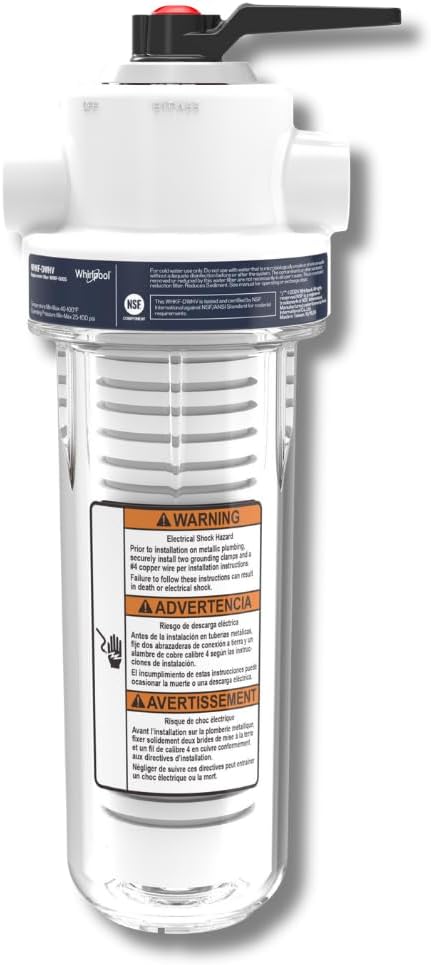
Will a 3-stage system remove PFAS or "forever chemicals"?
Standard carbon block stages remove some PFAS but are not certified to NSF/ANSI 53 for that contaminant. If PFAS is a known concern at your water source, add a point-of-use reverse osmosis unit at the kitchen sink for drinking and cooking water — that's the most cost-effective layered defense for a tiny home.
Key Takeaways
- Choosing the right whole house water system tiny home 400 square feet means matching capacity and output ports to your actual devices
- Always check actual watt-hours (Wh), not just watts — runtime depends on Wh, not peak output
- Also covers: tiny home water filter
- Also covers: compact whole house system
- Also covers: small footprint water softener
- Compare price-per-Wh across models to find the best value for your budget